


Key Takeaways
- The proptech market is set to jump from $40.19 billion in 2025 to $88.37 billion by 2032.
- 89% of C-suite leaders expect AI to transform real estate within five years.
- AI could generate up to $110-180 billion in value for the real estate industry.
- AI-driven real estate firms gain over 10% in Net Operating Income (NOI).
- To remain competitive, real estate must shift from intuition to an AI-driven, data-first strategy.
For years, the real estate industry operated on old-school methods.
Think endless manual paperwork, complicated transactions, and slow decision-making.
The sector was known for being slow to adopt technology, relying heavily on local broker expertise and intuition rather than clear, quantifiable data.
This dependency on precedent and gut feeling created huge inefficiencies and often meant limited transparency for everyone involved.
Now, proptech AI is changing all of that.
Proptech AI is not just about digitizing paperwork. It’s about injecting predictive power, automation, and deep intelligence into every stage of the property lifecycle, from zoning and construction to leasing and asset management.
Real estate is no longer just about “location, location, location.” It’s about innovation, intelligence, and transformation.
From AI-led decision-making to predictive analytics that forecast market movements, the sector is embracing a digital-first mindset that prioritizes speed, precision, and trust.
This technological leap allows the industry to move from reactive management to proactive asset optimization.
As a result, the global proptech market is projected to grow from $40.19 billion in 2025 to a massive $88.37 billion by 2032.
JLL Research reveals that 89% of C-suite leaders believe AI can help them solve major real estate challenges.
This isn’t incremental improvement; it’s wholesale transformation.
Transformation Across the Value Chain
The industry’s move toward AI is now a measurable trend accelerating across all verticals (residential, commercial, and industrial).
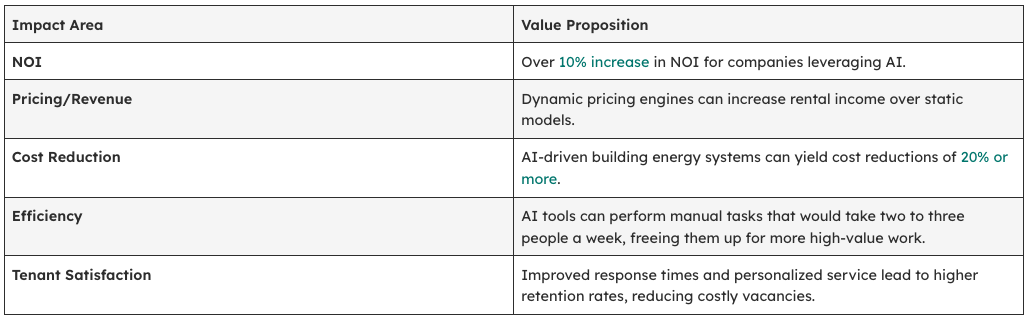
McKinsey analysis suggests that real estate companies leveraging AI have seen over 10% increases in net operating income through more efficient operating models and smarter asset selection.
These companies are leveraging Machine Learning (ML), Natural Language Processing (NLP), and Generative AI (GenAI) to tackle complex, data-heavy problems.
Intelligent Investment, Valuation, and Risk Mitigation
AI is fundamentally transforming how capital is deployed by replacing manual research with predictive analytics and Automated Valuation Models (AVMs). Traditional valuation relies heavily on recent comparable sales (comps). AI, however, processes thousands of variables simultaneously, including:
- Micro-local Data: Traffic patterns, school ratings, local business density, and noise levels.
- Macroeconomic Trends: Interest rates, employment figures, and regional migration.
- Geospatial Analysis: Proximity to new infrastructure projects (subways, highways) and zoning changes.
AI systems instantly analyze these vast data sets to forecast price trends and identify high-return opportunities that human analysis might miss. The ability to accurately forecast property value fluctuations is now a baseline requirement for market leadership.
Machine learning models have achieved 63% accuracy in predicting property valuations, providing a necessary shift from guesswork to data-backed insight.
Furthermore, AI-powered systems are excellent at scenario planning and risk mitigation. They can stress-test a portfolio against multiple economic conditions (e.g., a recession, a sudden jump in interest rates) far faster and more thoroughly than traditional financial modeling, offering unprecedented precision in underwriting.
Learn More: AI-Driven Property Valuation Models
Autonomous Operations and Maintenance
Proptech AI, leveraging the Internet of Things (IoT) and machine learning, is creating self-optimizing “Smart Buildings” that manage energy, security, and maintenance needs autonomously.
Predictive Maintenance: IoT sensors embedded in critical building infrastructure (HVAC systems, elevators, plumbing) continuously feed data to AI algorithms.
The AI detects minute anomalies, such as a slight increase in motor vibration or a slow pressure drop that can signal impending failure weeks before a human team would notice.
This proactive approach minimizes disruptions, extends equipment lifecycles, and dramatically cuts reactive repair costs.
Learn More: AI-Enhanced Predictive Maintenance for Property Management
Inspections and Audits: AI uses computer vision to analyze high-resolution images and video data from properties (roofs, facades, mechanical rooms) to conduct rapid damage assessments and identify code violations.
This technology provides objective, consistent analysis, reducing manual inspection time and human error.
Learn More: Using AI to Enhance Building Inspection
Energy Management: AI systems adjust lighting, heating, and cooling based on real-time factors like external weather forecasts, actual internal occupancy (detected via sensors), and energy pricing schedules. This leads to proven energy cost reductions of 20% or more.
This deep integration of technology also improves project control and efficiency during the initial build phase, helping to manage complex timelines and resource allocation.
Learn More: Simplifying Construction Project Management with AI
Generative AI and Customer Experience
AI accelerates creative and administrative functions while profoundly enhancing personalization in the customer journey.
Virtual Showcasing & Digital Twins: AI supports immersive Virtual and Augmented Reality (VR/AR) tours, allowing a buyer in London to virtually walk through a property in New York.
The use of digital twins; virtual replicas of physical properties that allows owners to visualize and simulate properties and their systems with unmatched realism for planning and marketing purposes.
Learn more: Digital Twins and AI Changing the Real Estate Landscape
Hyper-Personalization: AI analyzes buyer behavior, search history, and social media data to deliver highly targeted property recommendations, transforming passive searching into an active, curated experience. This level of personalized marketing is key to higher conversion rates across the industry.
Chatbots and Service: AI-powered conversational assistants handle initial inquiries, pre-qualify leads, schedule viewings, and manage maintenance requests instantly, providing 24/7 service and freeing human agents for complex advisory tasks.
Administrative and Compliance Automation
The back office, long known for its slow, paper-intensive processes, is being completely transformed by NLP and GenAI.
Document Concision: Using NLP, tools can instantly read, categorize, and summarize hundreds of complex legal documents.
This allows property managers to quickly review key clauses like insurance requirements or termination rights across an entire portfolio. The automation of tedious paperwork is one of the most immediate ROI drivers in proptech.
Learn More: 5 Simple Ways AI Speeds Up Real Estate Paperwork
Compliance Monitoring: AI automatically flags deviations in contracts or identifies regulatory changes that impact a portfolio, significantly reducing legal and financial risk.
The Business Impact: Quantifying Value
The integration of proptech AI delivers measurable financial and operational advantages across the entire asset lifecycle:
Overcoming Barriers: The Path to AI Adoption
Despite the compelling benefits, real estate organizations face significant hurdles that slow widespread AI adoption. Strategic investment and cultural shifts are required to overcome these challenges.
1. The Burden of Legacy Systems
Real estate is decentralized, relying on decades-old, siloed software systems that often don’t communicate. Many professionals cite integrating new technology as a major hurdle. This technical debt demands high upfront investment to migrate data, establish APIs, and create the unified data environment necessary for AI to function.
The Solution: Prioritize Data Infrastructure. Commit to unifying and cleaning data assets. Develop a strategic roadmap to consolidate disparate systems into a single source of truth (a data lake) before deploying AI models at scale.
2. Data Strategy and Ethical Governance
AI systems are only as effective as the high-quality, structured data they are trained on. Many firms struggle with data quality and governance, lacking standard protocols for collecting and labeling proprietary information.
Addressing ethical concerns like tenant privacy and algorithmic bias requires robust oversight.
The Solution: Establish Robust, Ethical AI Frameworks. Proactively develop internal guidelines for data collection, bias detection, and strict data privacy. This secures high-quality input for accurate models while maintaining user trust and compliance.
3. The Skills Gap and Cultural Resistance
Many companies plan to use AI extensively, most lack the required specialized skills, such as data scientists and prompt engineers. There is also cultural resistance, as seasoned professionals may hesitate to trust models over intuition.
The Solution: Invest in Upskilling and Change Management. Develop new training programs focused on data literacy and model interpretation for existing teams. Crucially, position AI as an augment to human expertise, building confidence through proven results to shift the culture from resistance to collaboration.
The Intelligent Evolution: Your Next Move
Real estate’s digital transformation isn’t coming, it’s here, intelligent, and already reshaping the industry one smart decision at a time. Proptech AI is redefining what it means to buy, sell, manage, and experience property.
The key to leadership in this new era is the strategic integration of technology. Your ability to leverage data for precision, foresight, and superior service is the new terrain on which you will compete for investor dollars, tenants, and longevity. The future of real estate is operational, intelligent, and being built right now.
Gaining a decisive competitive edge requires more than just piloting new apps; it requires a focused partner.
Ready to leverage proptech AI for your real estate business?
Contact Taazaa today to explore how our expertise in AI development and proptech solutions can accelerate your digital transformation and deliver a decisive advantage in today’s data-driven market.
Frequently Asked Questions (FAQs)
Q1: What exactly is proptech AI?
Proptech AI refers to artificial intelligence applications specifically designed for property technology—solutions that improve how real estate is developed, marketed, managed, and occupied.
Q2: How much value can AI generate for real estate companies?
McKinsey estimates AI could generate $110–$180 billion in value for the industry, with companies seeing over 10% increases in net operating income.
Q3: What are the biggest barriers to implementing proptech AI?
Key challenges include integrating new technology with legacy systems, ensuring data quality and governance, and developing organizational skills and systematic implementation approaches.
Q4: Will AI replace real estate professionals?
AI augments rather than replaces human expertise, automating routine tasks and freeing professionals for higher-value activities like strategic advisory and negotiation.
Q5: What should organizations do first when implementing Proptech AI?
Start with the “2×2” approach: identify two quick-win use cases and two aspirational, fundamental business-change use cases, focusing on business-led roadmaps.