

Key Takeaways
- DevOps replaces handoff-driven development with a continuous loop that aligns planning, building, testing, and monitoring.
- Choosing the right architecture, monolithic, microservices, or hybrid, depends on the product's scale, team size, and release velocity.
- CI/CD pipelines ensure code is always deployable, balancing speed with stability and reducing release risks.
- Containers and Kubernetes enable portability, autoscaling, and reliable cloud-native delivery without vendor lock-in.
Article Contents
Building great software isn’t enough. To stay competitive, businesses need to deliver that software reliably and at speed. However, for many organizations, software delivery is where momentum stalls. Delays in deployment, fragile releases, and disconnected teams create friction that compounds over time.
That’s where DevOps shines as a strategic capability. It brings together engineering, operations, and QA into a unified flow, removing handoffs and automating redundancies.
This article explores what modern DevOps looks like in practice and how Taazaa applies these principles to help teams go from bottlenecked to breakthrough.
DevOps is a Continuous Loop That Keeps Teams Aligned
In traditional software development, teams often treat delivery as a straight line: build, test, release, done.
But in practice, this creates gaps between developers and operations, between planning and execution, and between what’s shipped and what users actually need.
DevOps replaces that handoff-driven model with a continuous cycle, often visualized as an infinity loop.
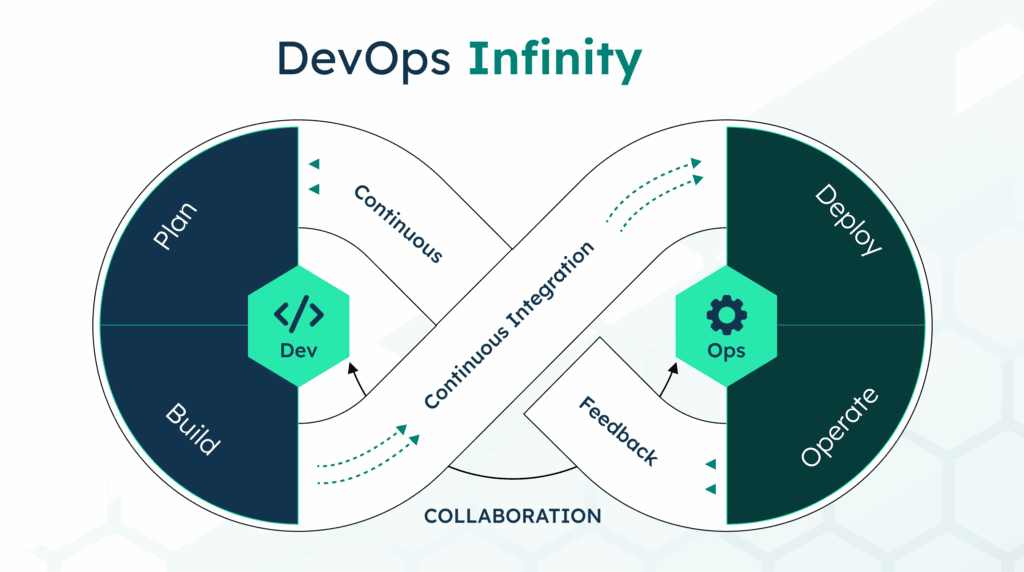
The Loop in Practice:
- Plan – Define goals and break them into measurable development tasks
- Develop – Build in small increments with version control and team visibility
- Test – Validate continuously using automation to flag issues early
- Deliver – Push to production or staging environments without wait cycles
- Operate – Maintain uptime, availability, and performance
- Monitor – Observe usage and feed insights back into planning
DevOps requires a mindset from one-time delivery to continuous improvement and from isolated teams to shared accountability.
This is how we operate at Taazaa. It’s how we help teams streamline delivery without sacrificing control.
Match Architecture to Your Velocity
Choosing between monolithic and microservices architectures is about aligning your structure with how your product is scaled and maintained over time.
At Taazaa, we don’t treat it as a binary decision. Many of the organizations we work with use a hybrid approach—starting with a monolith to move fast and gradually introducing microservices where scale, flexibility, or team independence demand it.
Each model has trade-offs. What matters is clarity about when and why you choose one over the other.
Monolithic vs. Microservices Architecture: What Fits Where?
| Factor | Monolithic Architecture | Microservices Architecture |
| Structure | Single codebase, tightly integrated | Loosely coupled services, independently developed |
| Release Cycle | Slower—entire app must be redeployed for every change | Faster—services can be updated individually |
| Team Autonomy | Centralized teams with shared ownership | Decentralized teams with clear service boundaries |
| Scalability | Scaling requires replicating the full application | Individual services scale independently |
| Rollback/Recovery | One bug can affect the entire system | Failures are isolated, easier to roll back specific services |
| Best For | Simpler apps, early-stage builds, tightly connected business logic | Large systems, evolving apps, or domain-driven designs |
| Challenges | Becomes harder to maintain at scale | Adds complexity in coordination, monitoring, and deployment |
What We Recommend
Start monolithic if you’re building something from scratch, need fast iteration, or your team is small and centralized.
Introduce microservices gradually as your system evolves—especially for parts of the app that need to scale, change frequently, or have independent teams working on them.
Avoid going “full microservices” unless your use case truly calls for it—it’s a powerful model, but not without overhead.
In delivery, structure follows function. Your architecture should be driven by how your software is used and what kind of change velocity you’re targeting.
Build Pipelines That Don’t Break
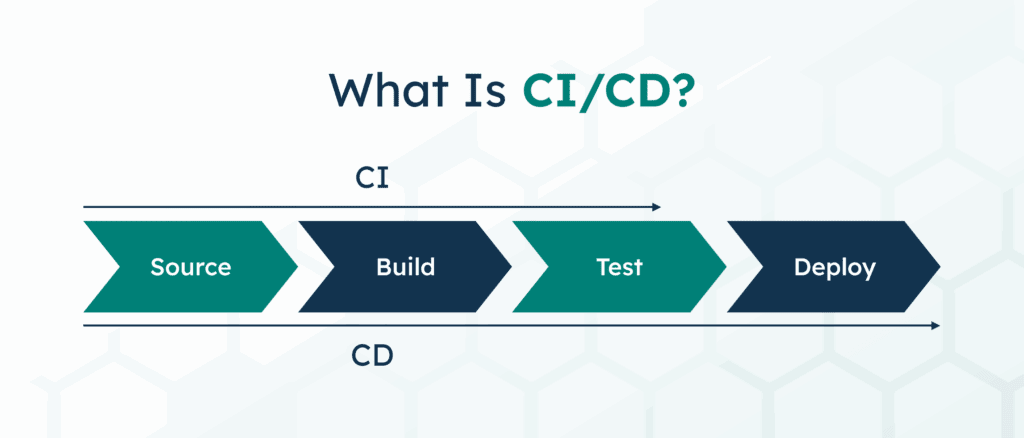
Speed without stability is a risk. Stability without speed is a bottleneck. Continuous Integration and Continuous Delivery (CI/CD) strikes a balance between the two.
In business terms, CI/CD means your code is always in a deployable state. Every update, every fix, every feature goes through automated checks and flows smoothly toward production without breaking the system or slowing things down.
What Continuous Integration (CI) Does:
CI ensures that developers can merge code frequently without conflicts, surprises, or downtime. Every time a developer makes a change, the system:
- Automatically pulls the latest code
- Runs a full suite of tests (unit, integration, regression)
- Flags errors or failures before they reach production
What Continuous Delivery (CD) Adds:
The CD takes the validated code from CI and pushes it forward toward staging or production environments. It automates:
- Packaging and versioning
- Environment provisioning
- Deployment, rollback, and release gating
As a result of which, teams don’t have to wait for fixed “release days.” They ship updates when they’re ready without disrupting operations.
What a Well-Oiled CI/CD Pipeline Looks Like:
A CI/CD pipeline begins the moment code is committed through Git. From there, the system automatically triggers a build using tools like Jenkins or GitHub Actions. As the build progresses, a comprehensive test suite runs immediately, covering everything from unit tests to full regression checks to ensure code quality.
Security scans follow to detect and flag any vulnerabilities early in the process. Once validated, the build is packaged into a version-controlled, deployable artifact.
Next, the pipeline provisions a staging environment that mirrors production, allowing for final validations in a safe, realistic setting.
If your delivery flow includes approval gates, these are handled through a mix of automated rules and human checks based on your compliance needs. Finally, the release is pushed to production, which is supported by automated rollback mechanisms to ensure quick recovery in case of any issues.
At Taazaa, we design CI/CD pipelines around what each organization actually needs—balancing team structure, codebase complexity, compliance requirements, and infrastructure realities.
That might mean using GitHub Actions for rapid deployments in a startup, Jenkins for advanced custom flows, or CircleCI for parallel testing across multiple environments.
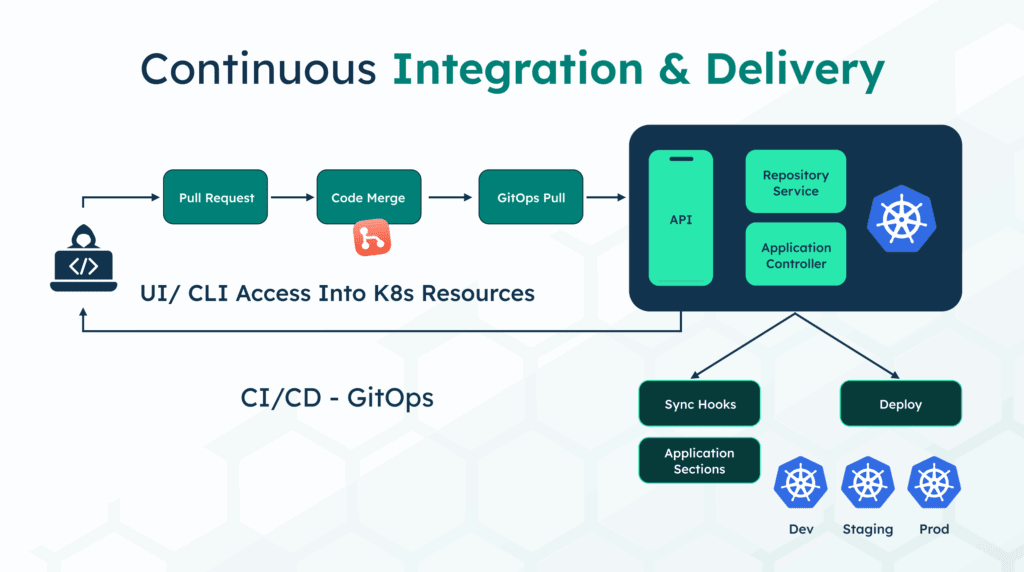
In cloud-native setups, we often layer in GitOps tools like Argo CD to handle deployment as code—particularly in Kubernetes-based environments.
Scale Smarter with Cloud and Containers
Cloud-native delivery makes modern software scale by decoupling applications from fixed infrastructure. Containers are at the heart of this flexibility.
A container packages everything your application needs—code, dependencies, configurations—into a portable unit. It can run reliably across environments, whether you’re testing locally, deploying to the cloud, or managing global-scale traffic.
When you’re running a single container, things stay simple. But when you’re coordinating hundreds across staging and production environments, often in different regions, orchestration becomes essential.
That’s where Kubernetes helps manage complexity by automating scaling, load balancing, deployment, recovery, and failover—so your system can adapt to demand and recover from outages.
At Taazaa, we design applications with a container-first mindset—typically using Docker—and manage deployments through Kubernetes alongside Helm and GitOps workflows.
Our CI/CD pipelines are built to handle versioning and rollback with precision, making releases safer and more predictable. We implement autoscaling strategies that respond to actual usage, not static thresholds, ensuring both performance and efficiency.
Importantly, we build with cloud neutrality in mind. That means you’re not locked into AWS, Azure, or GCP unless there’s a clear advantage. Flexibility and long-term control remain with you—not the vendor.
Taazaa’s Way of Doing DevOps
Our approach is lean, agile, and automation-first. But more importantly, it’s built on the belief that great software comes from breaking down walls—between developers, QA, operations, and the business itself. We don’t just optimize pipelines; we align teams around shared goals and create systems that can adapt to change without losing control.
We treat tooling as a means, not the mission. That means every decision is shaped by what your business needs to achieve. For us, flexibility, scalability, and clarity guide the architecture, and outcomes drive the choices.
This mindset has helped our clients move faster without compromising reliability. We help our clients shift from quarterly release cycles to weekly sprints, bringing new features to market faster while maintaining stability across their production environment.
Turn DevOps into Business Leverage
When releases are faster and feedback loops are tight, your teams can respond to the market with speed and confidence. It becomes easier to test new ideas, fix what’s broken, and scale what works.
In that sense, DevOps becomes an operational lever.
If you’re ready to explore what this could look like for your organization, contact us. We’d love to help you move faster with stability.