


Key Takeaways
- Move measurement from activity (e.g., model accuracy) to verifiable business outcomes.
- Measure AI across three axes: Efficiency (Cost/Time Savings), Effectiveness (Revenue/Quality), and Strategic Risk (Adoption/Compliance).
- You cannot prove AI value without first accurately measuring current performance (the “baseline”) before deployment.
- ROI calculation must account for continuous monitoring to catch model drift and measure value throughout the project’s lifecycle, not just at launch.
For enterprise leaders, the challenge with Artificial Intelligence (AI) has shifted. It’s no longer about testing the technology; it’s about proving its value.
Boards and CFOs now expect AI projects to compete with other capital allocations, but traditional return-on-investment (ROI) frameworks fail to capture AI systems’ nonlinear impact.
AI’s true ROI is complex. It involves not just direct cost savings, but a combination of long-term strategic benefits, risk mitigation, and continuous performance monitoring.
It compounds across cost savings, decision accuracy, customer retention, and entirely new revenue streams, while carrying hidden costs in data quality, governance, and model maintenance.
Failing to measure these elements means you are likely underestimating AI’s true value.
This guide details a multi-dimensional framework for measuring AI's ROI that moves beyond simple balance sheet cost-cutting to capture the full strategic, operational, and financial value delivered by intelligent systems.
The AI ROI Measurement Gap
Traditional ROI models are fundamentally unsuited for AI projects because they fail to capture the long-term, compounding, and often indirect benefits that intelligent systems generate.
AI investments are now judged by the same standards as any other strategic initiative, with measurable business outcomes and defensible returns. The burden of proof lies with business leaders, but AI value rarely shows up in a single metric.
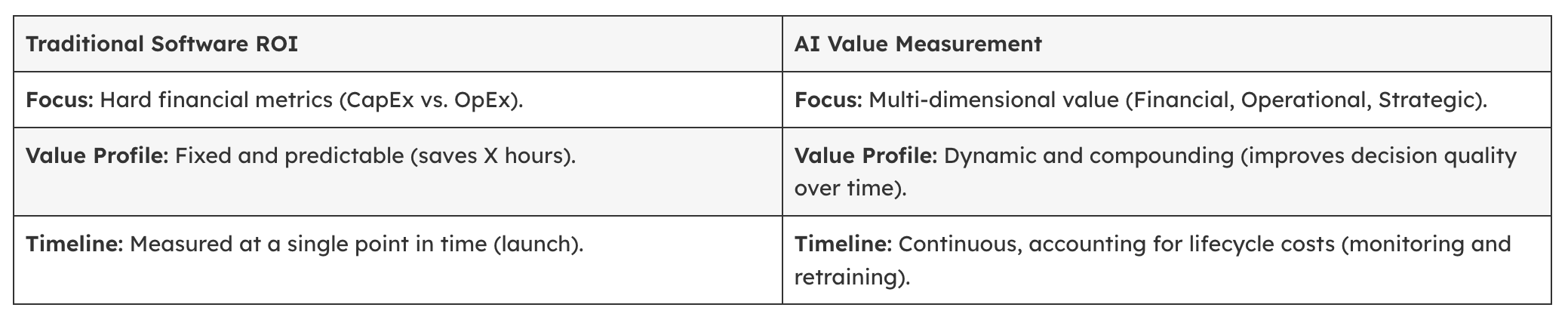
To justify the necessary scaling of investment from a successful pilot to an enterprise-wide platform, leaders must adopt a portfolio approach that quantifies value across three distinct domains.
This portfolio view prevents the organization from making quick wins while missing the opportunity for long-term transformation, a crucial step in preparing to scale gen AI pilots.
Foundations for Meaningful Measurement
For AI initiatives to prove their value, measurement cannot be an afterthought. It requires a disciplined foundation that ties every project to enterprise priorities.
- Start with Strategic Alignment: AI projects must relate directly to high-impact enterprise objectives. Projects that exist in isolation rarely move beyond experimentation and struggle to secure resources for scaling.
- Establish Baselines: No claim of improvement is credible without a clear, quantified picture of prior performance. Internal baselines demonstrate organizational improvement, while external benchmarks validate competitiveness in the broader market.
- Define KPIs and Hypotheses Early: With baselines in place, defining key performance indicators and hypotheses gives the measurement process rigor and predictive power. Executives should establish measurable hypotheses at the outset, forecasting, for example, that an AI system will reduce manual processing time by 50 percent within six months.
The Three Dimensions of AI Value
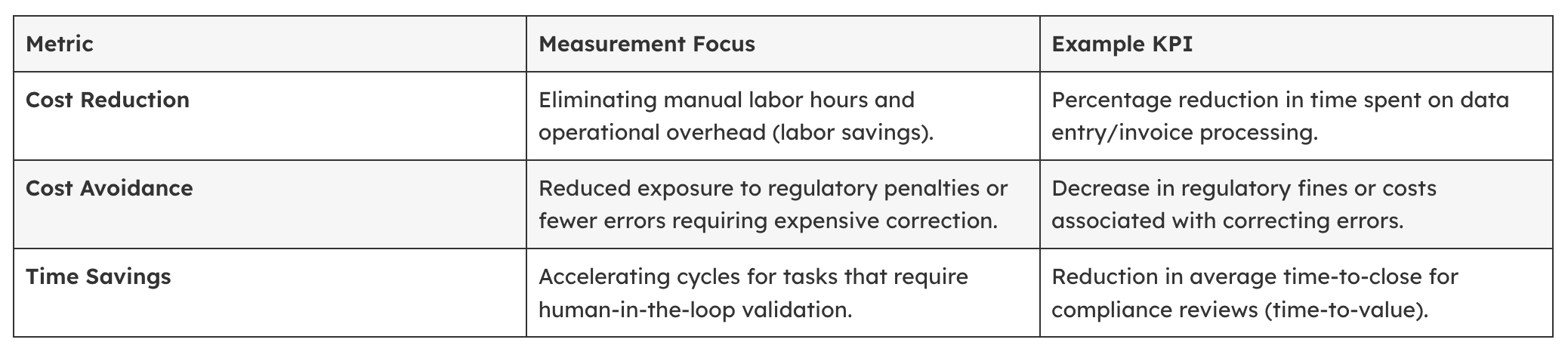
Measuring the success of an AI initiative requires tracking key performance indicators (KPIs) across three interdependent domains: Efficiency, Effectiveness, and Strategic Risk.
Efficiency Metrics (Hard ROI)
These are the direct, quantifiable savings achieved through automation, focusing on cost reduction and time savings.
Effectiveness Metrics (Growth and Quality)
These metrics track how AI improves the quality of output, driving better outcomes and increasing top-line growth.
Revenue Uplift: Measuring the direct impact of AI-driven personalization, predictive pricing, or targeted sales.
KPI examples include percentage increase in conversion rates, average deal size, or recurring revenue streams.
Accuracy and Quality: Tracking prediction accuracy (false positives/negatives), defect rates, and rework levels.
KPI examples might be improvement in prediction accuracy or reduction in rework or defect rates.
Customer Experience: Measuring service quality and loyalty (linking directly to revenue protection).
KPI examples include improvement in Net Promoter Score (NPS), reduction in average customer response times, or decreases in churn rates.
Strategic and Risk Metrics (Long-Term Value)
These indicators assess the long-term competitive positioning, organizational resilience, and ethical foundation of the AI system.
Risk Mitigation: Quantifying the reduction in exposure to fraud, compliance breaches, or reputational damage. Responsible AI ensures regulatory compliance and safeguards customer trust.
KPI examples could be percentage decrease in regulatory fines or reduction in fraud detection dwell time.
Adoption & Workforce: Tracking usage rates, employee satisfaction, and confidence in AI tools. This also includes monitoring the spread of AI-related skills across teams.
Innovation & Reusability: Tracking the number of new services or product features introduced through AI. This capability strengthens the foundation for all future AI investment, which is the core of maximizing AI Investments in 2026.
Accounting for True Total Cost of Ownership (TCO)
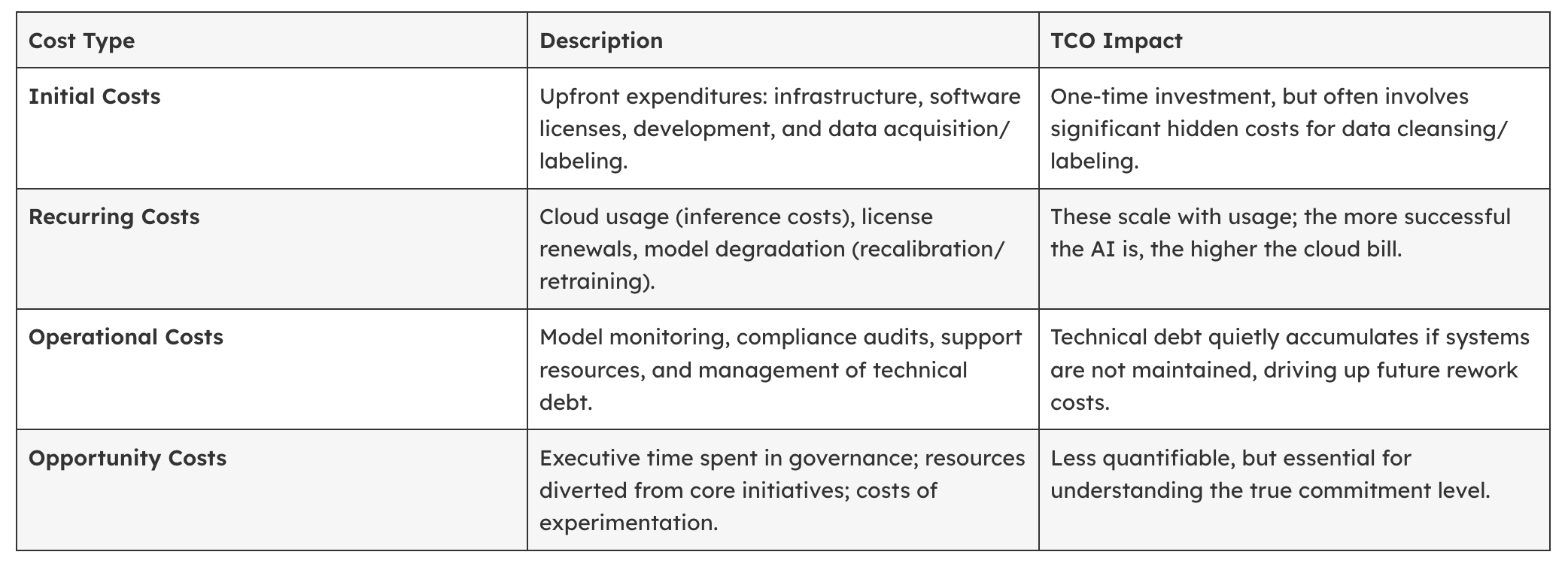
A comprehensive cost framework provides executives with a realistic picture of what it takes to sustain AI solutions, ensuring that ROI assessments are both credible and defensible.
The Hidden Tax of Recurring Costs
The misconception that costs decrease after launch is a common pitfall. AI systems require continuous maintenance and monitoring that often equals or exceeds the initial investment.
Calculating Net Value
Once costs and benefits are identified, ROI can be calculated in a structured way that builds credibility with boards and stakeholders.
The Formula: The standard financial calculation is: ROI (%) = (Total Benefits – Total Costs) / Total Costs * 100. The challenge lies in accurately monetizing the intangible benefits (like reduced risk or customer retention) and quantifying all ownership costs.
Net Benefit and Payback: Leaders must also evaluate the Net Benefit (absolute gain after costs) and the Payback Period (when cumulative benefits equal the initial investment). These measures help assess both the scale and timing of returns.
Attribution Risk: The most important element of credibility is transparent attribution. Leaders must use control groups and A/B testing to isolate and prove the value contribution of the algorithm itself and not attribute the entire benefit to AI when multiple initiatives run in parallel.
The Continuous Validation Loop
AI ROI is a continuous calculation. The measurement framework must be integrated into the AI lifecycle to account for model degradation and changing business context.
Model Monitoring: Continuous monitoring of the model’s accuracy, performance, and ethical compliance is essential to ensure sustained ROI and immediately catch “concept drift,” a loss of predictive accuracy as real-world data evolves.
Payback Horizon: AI rarely delivers full value in the first year. Evaluating ROI over a multi-year horizon provides a more accurate picture of impact. Using financial methods such as Net Present Value (NPV) helps align AI evaluations with broader corporate finance standards.
Failing to build this rigorous framework means the model is deployed at high risk, sacrificing the stability and trust required for scale.
Learn More: How Do You Test and Validate AI Features Before You Go All In?
Value Measurement Drives Strategy
Focusing solely on efficiency metrics (cost savings) is a primary reason AI initiatives fail to gain momentum. True ROI emerges when leaders embed measurement across the three dimensions of value—Efficiency, Effectiveness, and Strategic Risk—and commit to continuous, life-cycle validation.
By making the shift from measuring activity to measuring impact, organizations secure the necessary funding, build organizational confidence, and ensure their AI investment becomes a durable engine of competitive advantage.
Ready to build an AI strategy that captures verifiable business value? Taazaa specializes in designing custom AI solutions and implementing the governance and metric frameworks necessary to track and maximize your ROI from day one.
Contact our experts today to see how Taazaa delivers custom AI with real ROI.