Civi AI Cuts Tax Return Processing Time from Days to Hours
Financial Services
AI Workflow Automation
Key Takeaways
The City of Dublin, Ohio, needed a modern, automated solution to streamline tax return processing.
Taazaa built an AI-powered document processing platform that eliminated the manual pipeline.
The solution became a new product called Civi.
By automating data extraction from tax forms, Civi reduced processing times from days to hours.
The AI achieved up to 85% accuracy before auditing.
The Challenge
The City of Dublin, Ohio, struggled with an outdated tax processing system that required municipal employees to manually enter data from complex tax forms, leading to significant delays in return processing. Because the manual data entry and physical letter notifications to taxpayers were slow and labor-intensive, the city was missing quarterly revenue collection deadlines.
Auditors spent thousands of hours each year scanning bulk documents, sorting them by form type, manually keying data into their taxation portal, and then, in theory, auditing the results for accuracy and compliance. In practice, the volume of returns overwhelmed the staff. Most returns were approved without substantive review. The auditors were not auditing. They were performing data entry.
The municipality did not have a technology problem in the traditional sense. Their portal worked, and their filing systems were functional. What they had was an operational bottleneck where every document passed through human hands for tasks that did not require human judgment.
The city required a modern, automated solution to extract data from scanned tax forms, apply business rules to calculate taxes or refunds, and ensure accuracy, all while remaining secure and accessible only to municipal employees. The new system also needed to handle both standardized and non-standardized forms, with plans for future e-filing and data migration from the old system.
The solution: Civi, an AI tax assistant built by Taazaa.
The Solution
The conventional modernization response would be to replace the entire system. Taazaa proposed a different approach: identify the stages where manual effort adds no analytical value, and replace those stages with AI while leaving the functional systems intact.
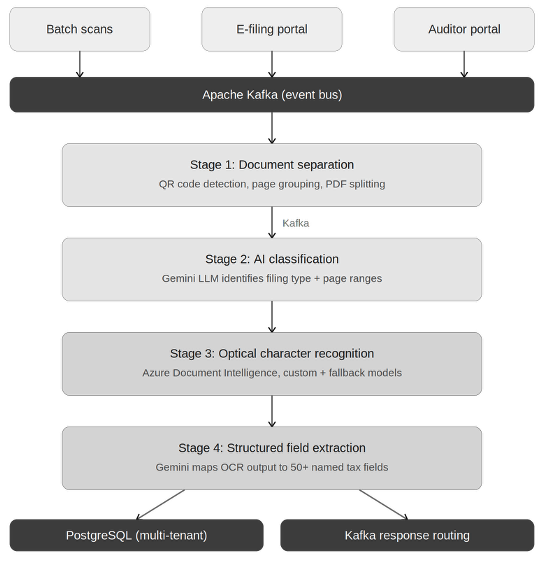
Taazaa built an AI-powered document processing platform that eliminates the manual pipeline from intake to structured data. The system ingests tax documents from three channels (bulk batch scans, an e-filing portal, and an auditor portal) and processes them through four automated stages.
The back-end, built with Python and Java, used PostgreSQL and MongoDB for data storage, with Apache Kafka enabling seamless inter-component communication. The front-end, developed using Next.js with TypeScript, incorporated Tailwind CSS and Ant Design for styling, Vitest for unit testing, and React Query for efficient API calls. ESLint, Prettier, Lint Staged, and Husky ensured code quality.
For the AI, the system integrated Microsoft Azure’s Document AI and Google’s Gemini, alongside Python and JSON, to scan and extract data from PDF tax forms, storing values in a database. The AI extraction achieved up to 80-85% accuracy, and an edit functionality was implemented to allow municipal auditors to manually correct or input missing values.
The platform was designed exclusively for municipal employees and was not accessible to the public. It featured customized data models to read any PDF form, including non-standard text or value formats. Middleware ensured data integrity, and business rules computed taxes or refunds.
Stage 1: Document Separation
Bulk-scanned PDFs often contain hundreds of pages spanning dozens of individual returns. The system renders each page, detects QR code boundary markers using computer vision, and splits the bulk file into individual tax returns. Four separator types are supported, each configurable per municipality tenant.
Stage 2: AI Classification
Each separated document is classified by filing type (Business, Individual, or Withholding) using Google Gemini. The classifier identifies page ranges for each form within a document. Results are cached at the database level to prevent re-classification of previously processed documents.
Stage 3: Optical Character Recognition
Classified documents are routed to Azure Document Intelligence for text, table, and key-value pair extraction. Custom OCR models are deployed per form type for higher accuracy, with automatic fallback to a general-purpose layout model if the custom model fails.
Stage 4: Structured Field Extraction
Cleaned OCR output is fed into Gemini with database-driven prompt templates and field definitions. The LLM maps unstructured text to over 50 named tax fields. Extracted values are normalized, validated, and persisted into relational tables. Taxpayer identifiers are protected by high-security encryption at rest and hash-based deduplication. Sensitive data never reaches the LLM in unencrypted form.
The Results
Civi enabled the City of Dublin to meet revenue-collection targets more efficiently. By automating data extraction from tax forms, the system eliminated manual entry, reducing processing times from days to hours.
Tasks that previously delayed quarterly deadlines were streamlined, allowing the city to process more returns within target periods and boost revenue inflow.
The edit functionality ensured accuracy by allowing auditors to address the 80-85% AI extraction accuracy swiftly. Powered by a sophisticated tech stack, the platform can handle both standardized and non-standard forms. Due to other applications lacking API support, the Tax Filing application uses RPA to export the data into another city system.
Dublin auditors now spend their time on substantive tax review, which is the work they were originally hired to do. Documents flow from intake to structured data without human intervention unless the system flags an exception.
The modernization was achieved without replacing the municipality’s existing tax portal or filing infrastructure. The AI platform operates as an intelligent layer between document intake and the downstream systems already in place.
With planned e-filing, the solution promises further efficiency gains, earning trust from municipal stakeholders through reliable delivery and setting the stage for broader adoption across U.S. municipalities.
Now, tax bureaus across the United States can leverage the power of Civi AI to streamline their tax processing workflows.
Modernizing our tax operations was a priority for our city. Civi gave us a platform that is intuitive for residents, efficient for staff, and flexible enough to support our long-term goals.