


Key Takeaways
- 91% of hospitality leaders are using AI, yet only 28% have an enterprise-wide strategy.
- AI is reshaping hospitality in 4 key areas: the guest experience, channel management, human resources, and operations and data infrastructure.
- Guest personalization is the leading AI use case at 57.6%, with forecasting, customer service automation, and revenue management gaining traction.
- The top barriers to scale are legacy system integration, cited by 85% of leaders, and talent shortages, cited by 76%.
- 77% of hospitality leaders believe AI will create new roles over the next five years, with 91% expecting human work to shift toward higher-value tasks.
Businesses across the industry spectrum have been impacted by AI, and the hospitality sector is no exception.
PwC's January 2026 survey of C-suite and senior leaders across hotel groups, travel providers, and destination management organizations in the Middle East found 91% are already piloting or using AI.
Despite this widespread adoption, only 3% have achieved enterprise-wide deployment.
The pattern is not unique to the region. A study of 113 hotel chains found that 91% use AI, but only 28% have an enterprise-wide strategy. Respondents identified skills gaps and integration challenges as the leading roadblocks to success at scale.
Most hospitality organizations deploy AI against existing workflows rather than designing workflows around desired outcomes. This approach results in efficiency gains but doesn’t deliver the transformation most organizations expect.
Four Areas Where AI Is Reshaping Hospitality
PwC's analysis identifies four focus areas where AI is creating the most significant operational and commercial change: the guest experience, channel management, human resources, and operations and data infrastructure.
Guest Experience
Today's guests expect interactions designed specifically for them. AI makes this possible by drawing on real-time preference data, booking history, and behavioral signals to anticipate what a guest needs before they ask.
However, there’s a fine line between personalization and invasion of privacy. Guest data must be used wisely and with restraint and guest consent. When done right, guests feel valued, seen, and welcome; when not, they feel watched, exposed, and uncomfortable.
Guest personalization is the leading current AI use case, cited by 57.6% of survey respondents. Secondary applications gaining traction include:
- Forecasting and demand prediction
- Customer service automation
- Revenue management optimization
- Loyalty and CRM analytics
Operations and Data Infrastructure
Behind every guest interaction lies a web of booking systems, payment platforms, and logistics tools. In most hospitality organizations, these are fragmented and disconnected. This can be a roadblock, because AI can’t improve what it can’t access.
The practical approach is to connect legacy infrastructure intelligently rather than replace it. A hotel does not need a new property management system to optimize housekeeping schedules with AI. It needs existing data to be clean, governed, and accessible.
Back-end use cases with the most untapped potential include energy optimization, asset management, and procurement. Each registers adoption rates below 25% in PwC's survey, despite offering clear, measurable returns.
Human Resources
High turnover, widening skill gaps, and difficulty attracting digital professionals are structural constraints that AI alone doesn’t resolve. What it can do is make the existing workforce more capable and more effectively deployed.
Key applications include:
- Adaptive learning platforms that tailor training to individual employees
- Predictive scheduling that reduces over- and understaffing
- Internal mobility tools that reveal employees with underutilized skills
- Performance analytics that identify development opportunities in real time
PwC's survey found that 77% of leaders believe AI will create new roles over the next five years and 91% expect human responsibilities to shift toward higher-value work. The concern is preparation, not displacement. Currently, 60% of respondents only allocate between 10% and 25% of their AI budget to employee upskilling.
Channel Management
Travelers increasingly discover and book through AI-powered platforms that show them only properties with real-time, readable, and well-integrated data. Operators without an API-first architecture will not appear in these results because their data is not in a format these platforms can read.
89% of survey respondents will prioritize generative AI in the next one to two years, with 86% prioritizing predictive analytics. The commercial applications are dynamic pricing, demand forecasting, and reputation monitoring, all of which depend on real-time data integration.
Industry Constraints on AI Scalability
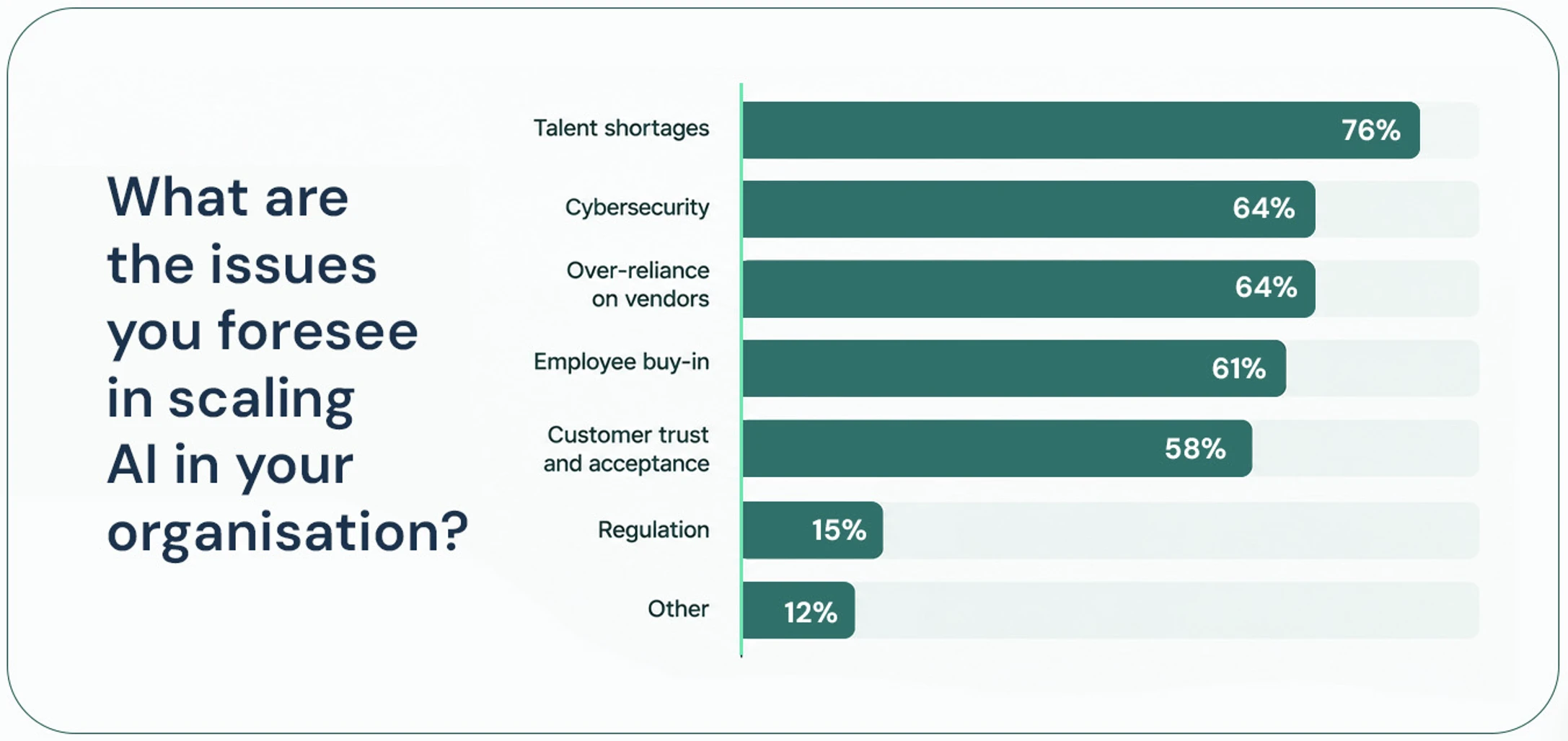
Despite widespread activity, AI is present but not productive at scale across most hospitality organizations. The industry faces several constraints on scalability and impact.
- Legacy system integration: Outdated platforms limit real-time data processing and prevent AI tools from connecting across the operational systems they need to function.
- Talent shortages: High turnover among digital professionals and limited investment in upskilling leave most organizations dependent on external vendors.
- Data privacy and cybersecurity: Guest data is the raw material for most AI use cases, and the regulatory environment around it is complex and evolving.
- “Soft” barriers: Employee resistance and a lack of consumer trust and acceptance can hinder adoption and impact the ROI of AI initiatives.
Additionally, 46% reported budget constraints, and 42% said a lack of strategic alignment around AI hindered implementation and scaling, pointing to a need for greater leadership buy-in.
Transformation Best Practices
One of the biggest missteps organizations can make is attempting wholesale transformation from the outset. Starting small and applying intelligence to what’s already available helps deliver measurable results that can be built on incrementally.
Three recommendations help hospitality AI initiatives produce measurable returns.
- Start where impact is high. Find a use case that significantly improves efficiency or increases revenue. A quick, visible result builds confidence.
- Demonstrate ROI quickly. 71% of respondents have less than 3% of their annual budget allocated to AI initiatives. Early deployments that produce a return on the investment help loosen the purse strings for further exploration.
- Ensure data quality. AI output is only as good as the data input. Make sure the data used is clean, accurate, and relevant to the outcome or goal the organization is looking to achieve.
Some use cases deliver results faster than others. To learn more, check out Taazaa’s guide to agentic AI use cases that deliver ROI.
Ask Five Questions
Before any deployment begins, teams should explore five questions to determine the design:
- What result are we trying to create?
- How does that work get done today?
- What data does it depend on?
- Where can AI help?
- Where do people retain control?
In hospitality, that last question determines whether the AI layer enhances or undermines the experience it was deployed to improve.
Effective AI deployment in hospitality also requires an infrastructure that many internal teams underestimate: clean, connected data across booking systems, PMS, and CRM platforms; governance frameworks that define who reviews what; and human oversight built into the workflow before any agent runs, not added after the first failure.
The reason these teams often misjudge the project’s complexity is that they don’t have experience building enterprise-scale AI systems. This leads them to underestimate the integration complexity, governance requirements, and evaluation discipline required to move from a working prototype to a production-grade agentic system.
In such situations, it’s often more cost-effective to leverage a technology partner with experience helping enterprises build scalable AI solutions.
If that describes your situation, explore Taazaa’s AI capabilities and hospitality solutions.
Frequently Asked Questions
What is the biggest barrier to scaling AI in hospitality?
Legacy system integration was cited by 85% of leaders as a roadblock to scalable AI. Talent shortages at 76% and data privacy concerns at 64% follow closely.
Why is AI producing efficiency gains but limited revenue impact?
Most deployments automate existing tasks rather than redesigning the workflows that drive revenue. Only 3% of leaders report transformational revenue impact.
Will AI reduce hospitality employment?
77% of hospitality leaders believe AI will create new roles over the next five years, with 91% expecting employees to shift toward higher-value work.



.webp)