


Key Takeaways
- Forrester CEO George Colony predicts that 70% of AI-generated revenue will flow through private models within five years, not public ones.
- Efficiency gains from AI are real, but they are not a competitive advantage. Winning, serving, and retaining customers is.
- Private AI's value comes from proprietary training data, not the model itself. The data is the moat.
- Organizations delaying private AI are handing competitors a compounding advantage that gets harder to close every quarter.
- Getting the architecture wrong early is expensive to undo.
Most organizations ask the wrong question about AI.
They ask how to deploy it faster, automate more tasks, and cut costs. Those are all legitimate questions.
But they aren’t the questions that will define who comes out on top over the next decade.
Forrester CEO George Colony recently predicted that, in five years, 70% of AI-generated revenue will come from private AI models, not public ones. Why? Because business leaders, employees, and the business’s customers trust private models more. Or rather, they trust the company, and therefore they trust the company’s AI.
Companies making moves now to own their AI infrastructure, train it on their own data, and keep it within their own governance boundaries are the ones that will be industry leaders in a few years.
What Is Private AI, Exactly?
Private AI is a model deployed within infrastructure you control, where your data never leaves your governance boundary during processing. It could live on your own servers, in a dedicated cloud environment, or in an isolated virtual private cloud.
When you compare them side by side, the differences between public and private models are fairly evident.
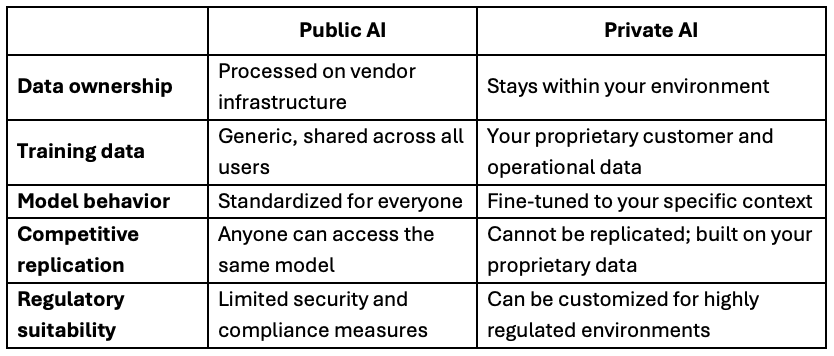
For low-stakes tasks, public AI is a reasonable tradeoff. For decisions touching customer relationships, financial data, or competitive intelligence, private AI reduces the exposure to risk.
More importantly, it creates something public AI fundamentally cannot: a model that learns from your data alone, develops pattern recognition specific to your customers, and produces outputs no competitor can replicate.
How Does Private AI Generate Revenue?
Organizations default to measuring AI success in costs saved and hours recovered. Those gains are real but finite, and increasingly, they’re table stakes.
Greater gains come from winning, serving, and retaining customers. Private AI drives revenue through three distinct mechanisms.
Personalization That Converts
An AI model trained on years of your customers' purchase behavior, support history, and product usage patterns develops an understanding of each customer that no public model can match.
A logistics company running a private model on three years of customer interaction data can surface the right upsell at exactly the right moment, not from a generic rule set, but from pattern recognition specific to that company's customer base. That translates into higher conversion rates, lower churn, and stronger lifetime value.
Predictive Revenue Intelligence
Private AI gives revenue operations teams a fundamentally different forecasting capability. Instead of historical averages or human intuition, organizations can build models that identify:
- Which accounts are at risk of churning, weeks before it shows in the CRM
- Which accounts are primed for expansion, before a rep has noticed the signals
- Where pipeline gaps will emerge and when to act on them
This extends to pricing and product strategy. A model continuously trained on usage data and support patterns can flag demand trends before competitors spot the same signals in aggregated public datasets.
New Revenue Categories
For product and technology companies, private AI opens revenue lines that simply didn’t exist before, such as AI-powered features built on customer data, AI-assisted services where data privacy is a precondition for the sale, and AI-driven insights sold back to customers based on their own behavior.
These categories require private infrastructure. Companies with that infrastructure can build them. Those relying on public APIs generally cannot.
Why Is Proprietary Data the Real Competitive Moat?
There is a persistent misconception about what makes private AI valuable. Most organizations focus on which foundation model to use, how large it should be, and whether to fine-tune or train from scratch.
These are legitimate implementation questions, but they’re downstream of the question that actually determines value: What proprietary data do you have, and what are you doing with it?
That data is what can’t be purchased or replicated. It represents years of customer interactions, operational decisions, and market activity.
Amazon is a prime example of how to build this kind of competitive moat. Amazon's advertising business reached $68 billion in revenue in 2025, not because its models are superior to competitors', but because the proprietary behavioral and transaction data flowing through its closed-loop ecosystem can’t be replicated.
And that data advantage compounds. Every customer interaction, every transaction, every support ticket adds to the training corpus. Private AI learns more about your business every quarter, continuously widening the gap between your model and a generic public one.
For more on how AI security architecture protects that data asset, see our article on securing AI systems from AI-driven threats.
Why Does Waiting on Private AI Create More Risk?
Organizations building private AI capabilities now are accumulating two things their competitors cannot buy later: proprietary training data and institutional knowledge of how to operate AI at scale.
For organizations with legacy systems that impose constraints, the clock runs even faster; an architecture not designed with AI integration in mind needs modernization before private AI can deliver on its revenue potential. Our white paper on modernizing legacy systems with AI outlines the key decisions and a realistic path forward.
PwC's 2025 AI Agent Survey found that 88% of executives plan to increase AI-related budgets over the next 12 months, driven by agentic AI's potential. The businesses not investing in private AI are watching competitors accumulate a data advantage that compounds every quarter.
Learn more: How Does AI Fit into Your Technology Budget?
Getting Private AI Architecture Right
Private AI isn’t a product you buy; it’s an infrastructure you build. And early decisions have long tails.
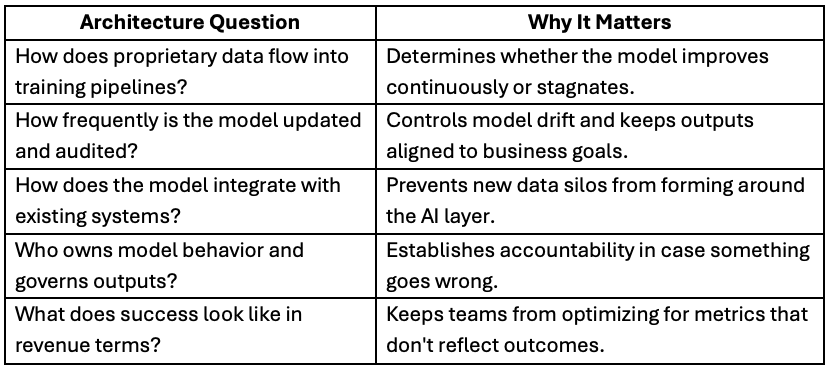
Organizations that treat private AI as a standalone deployment consistently hit the same wall. The model works in isolation, but it doesn’t integrate with the systems where customer data actually lives. There is no governance for model updates. And when the model produces a surprising output, there is no clear owner to resolve it.
The questions that matter most aren’t about the model. They’re about the architecture. These are some of the questions to ask when planning a private AI implementation:
Learn more: Agentic AI at Scale: Laying the Right Foundations
Efficiency Is Not the Endgame
Efficiency gains from AI are real. They are also becoming table stakes; every company deploying AI will capture some of them. They are not the basis for a durable competitive advantage.
Colony's projection puts a number on where value is concentrating: 70% of AI-generated revenue flowing through private models within five years. That is not a distant forecast. It is happening now, in the architectural and data decisions organizations are making today.
If your organization is ready to move forward with a custom private AI solution, talk to the Taazaa team. We work with growing mid-market and enterprise organizations to build AI infrastructure grounded in business outcomes.
Frequently Asked Questions
What is private AI, and how does it differ from using a public AI tool?
Private AI means deploying a model within infrastructure you control (your own servers, a dedicated cloud environment, or an isolated virtual private cloud), where your data never leaves your governance boundary. Public AI tools process your prompts and data on shared vendor infrastructure. Private AI lets you train on proprietary data, audit model behavior, meet stringent regulatory requirements, and build capabilities no competitor using public tools can replicate.
What data does an organization need to make private AI valuable?
The most valuable training data is longitudinal and specific to your customers: transaction histories, support logs, product usage telemetry, and sales conversation records. Depth and specificity matter more than volume. A well-structured three-year dataset from your own operations will consistently outperform a larger generic dataset when the goal is outputs relevant to your specific market.
What are the most important architectural decisions before deploying private AI?
The decisions that matter most are not about the model; they are about what surrounds it. How does proprietary data flow into continuous training pipelines? How does the model integrate with operational systems? What governance framework controls updates and audits outputs against business outcomes? Organizations that answer these questions before selecting a model avoid the expensive rebuild that comes from getting the architecture wrong early.