

Key Takeaways
- Telehealth encounters rose 79% between 2019 and 2026, and remote patient monitoring increased nearly 4,000% in the same period.
- The shift inside health systems is not about more virtual visits but about redesigning which work requires physical presence.
- EHR integration is what makes virtual care accountable. When clinicians share the same record, handoffs improve, and patients no longer have to bridge disconnected systems.
- The financial model has not kept pace with adoption. Telehealth margins remained negative across all payer categories in 2025.
Telemedicine has grown and evolved since the COVID-19 pandemic. It’s no longer just patients connecting with physicians from home. Increasingly, telemedicine is being used inside hospitals, where virtual care is being woven into the clinical operating model in ways that have little to do with patient-facing screens.
Telehealth encounters rose 79% between January 2019 and January 2026, per Strata Decision Technology's June 2026 Performance Trends report. Remote patient monitoring increased nearly 4,000% in the same period.
Health system leaders are now exploring where a doctor’s physical presence has the greatest impact and where virtual resources can provide meaningful support. They’re redesigning care delivery, deciding which functions require a clinician at the bedside, which expertise can be distributed, and how virtual and in-person roles can operate as one team.
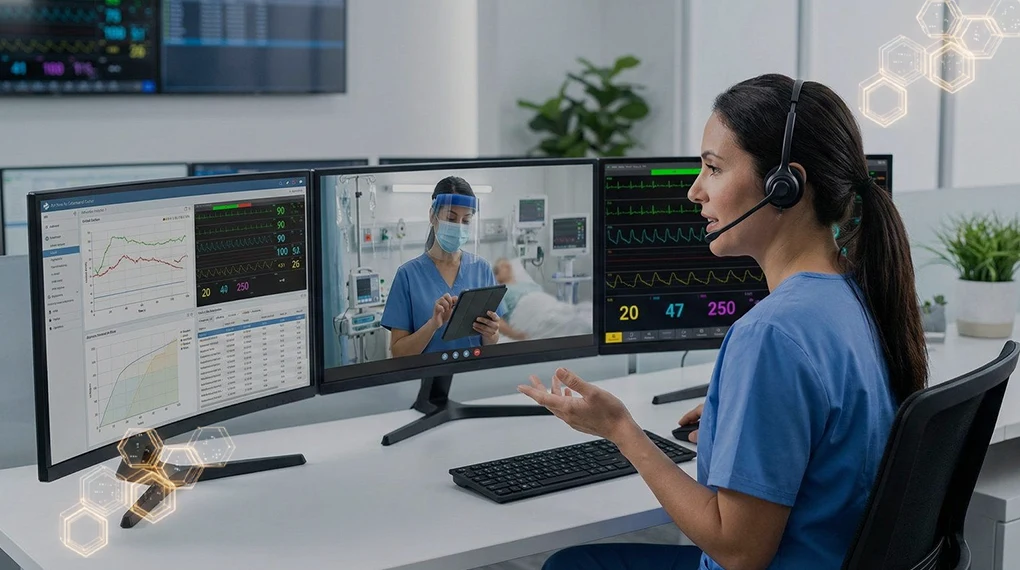
Some health systems use live video tools for interactions involving patients and multidisciplinary care teams in ICUs, hospital rooms, emergency departments, and other settings.
“We've found that integrating bedside and virtual care increases clinical efficiencies, improves patient safety, and leads to higher patient satisfaction," said Dr. Matt Anderson, senior VP and chief physician officer for Advocate Health.
Embedded Virtual Care
Health systems are deploying different models of embedded virtual care, each addressing a different staffing or geography constraint.
At Ochsner Health, the Virtual Nursing Admit/Discharge Program centralizes administrative and coordination tasks that previously consumed bedside nursing time. Virtual nurses handle admission documentation, discharge coordination, and care transitions. Bedside nurses retain capacity for hands-on care.
Tele-ICU adds remote critical care coverage. During a code blue, a virtual nurse documents in real time, allowing the clinicians in the room to focus entirely on the patient. Overnight, virtual intensivists cover periods when onsite staffing is thinner.
Rachelle Longo is the assistant VP of virtual care at Ochsner, as well as a member of the American Telemedicine Association Center of Digital Excellence Steering Committee. She says Ochsner looks for where physical presence matters most, and where virtual resources can provide meaningful support.
“This shift helps us preserve bedside staffing, reduce burnout, and ensure that scarce expertise is available where it's needed most, regardless of geography or time of day,” Longo said.
Virtual specialty coverage allows a local care team to combine their knowledge of the patient with a virtual consultation from a specialist. This helps avoid unnecessary patient transfers and expands access to specialty care.
EHR Integration
A single virtual encounter is part of a longer care journey, and must be treated as such. It requires coordination between clinical leadership and clinicians who serve patients both virtually and in person, with shared measurement and decision-making.
Amy Lukowski, VP of operations and integration at Ovatient, sees electronic health records (EHR) as the crucial element that connects virtual and in-person clinicians.
“For health systems, building virtual-first care models natively in EHRs is the ultimate differentiator,” Lukowski said. With a dedicated virtual primary care team, care becomes part of the existing medical record, “without putting the onus on the patient to connect the dots.”
Information Infrastructure
Lukowski said that to make virtual-first care work at the system level, health systems need:
- Dedicated virtual teams
- Team-based care
- Knowledge of local systems and communities
- Native EHR integration
- Measurement goals established before care begins
The benchmark is whether virtual care can meet or exceed what patients receive in person.
As virtual clinical roles become standard, the information infrastructure supporting those roles becomes equally important. Clinical teams distributed across physical and virtual settings need fast, accurate answers about policies, procedures, and patient context without interrupting care.
That information needs to be available in context, through the interface the clinician is already using. A system that requires a separate login, a different screen, or a manual search adds friction and leads clinicians to abandon the system.
From Program to Operating Strategy
Longo expects virtual roles to become standard care team members, with virtual nursing, virtual ICU, and virtual intensivists expanding alongside roles not yet fully defined.
Anderson believes this is not simply about adopting the next new thing. It’s fundamentally changing the way health systems deliver care to better meet the evolving needs of patients and communities.
The future of telemedicine is making specialty expertise available where it is most useful, preserving scarce hands-on capacity, and connecting virtual and physical teams around a patient journey that moves between both.
Taazaa has helped many health systems build telemedicine solutions and AI-assisted tools that support distributed clinical teams and make virtual care operationally reliable at scale. Learn more about our healthcare solutions.
Frequently Asked Questions
What is driving the evolution of telemedicine inside hospitals?
Workforce constraints and geography. Health systems are using virtual nursing, tele-ICU, and remote specialty coverage to distribute scarce expertise and reduce unnecessary patient transfers.
What is the difference between a telehealth visit and integrated virtual care?
A telehealth visit addresses one moment. Integrated virtual care connects the encounter to subsequent steps, records it in the shared EHR, and measures it against the same outcomes standards as in-person care.
Why is EHR integration critical for virtual care?
When virtual and in-person clinicians share the same record, they coordinate care without asking patients to bridge disconnected systems. Integration is what makes virtual clinicians accountable members of a care team.