


Key Takeaways
- KPMG’s Q2 2026 Global AI Pulse survey of 2,145 leaders across 20 countries found that only 7% have established AI ROI.
- IBM found only 29% of executives can confidently measure AI ROI today, despite 79% already seeing productivity gains.
- McKinsey’s April 2026 analysis identifies a five-layer measurement framework that connects AI performance to financial impact.
- The era of AI experimentation is over. Success now depends on delivering measurable, repeatable performance.
A shocking number of businesses don’t know how well their AI systems are performing.
They don’t know if anyone’s using the solutions they’ve built for them. They can’t tell whether the customer experience has improved or worsened, much less whether they’ve created a competitive moat. And they haven’t seen an impact on the bottom line.
KPMG’s Q2 2026 Global AI Pulse survey of 2,145 C-suite leaders across 20 countries found only 7% have seen a return on their AI investments. IBM’s research found only 29% of executives can confidently measure AI ROI, despite 79% already seeing productivity gains. And in a recent McKinsey survey, 60% of respondents have yet to see an enterprise-wide impact on EBIT from their AI programs.
“The gap between AI activity and AI impact only seems to be widening,” the McKinsey report said.
The most common cause of this gap is that organizations aren’t measuring the right things, so they don’t know what to scale to deliver greater impact.
Why Measurement Fails Before It Starts
The most common measurement failure in AI programs isn’t getting the numbers wrong; it’s tracking the wrong numbers from the beginning.
Many organizations deploy AI in ways that are more visible than valuable, the McKinsey report found. AI tools such as chatbots, copilots, and summarizers help employees work faster but rarely change a P&L.
AI deployments that automate end-to-end workflows within specific domains transform the work, yet leaders still struggle to prove the impact of these systems. When teams disagree on what aspects to measure and how to measure improvements, they can’t justify additional budget to scale the system.
Deloitte’s 2025 research found only 25% of organizations have moved 40% or more of their AI pilots into production. The pilot trap, the pattern of releasing AI pilots without ever scaling them, is a symptom that the right things aren’t being measured.
Escaping the pilot trap and seeing an accurate picture of AI’s impact requires the same rigorous measurement as any other major investment. Organizations need a system that connects AI’s performance to business outcomes.
The Five Layers That Connect AI to Business Value
McKinsey outlines a five-layer framework that establishes an auditable line from model performance to financial impact, with each layer clarifying ownership, metrics, and how it all connects to enterprise impact.
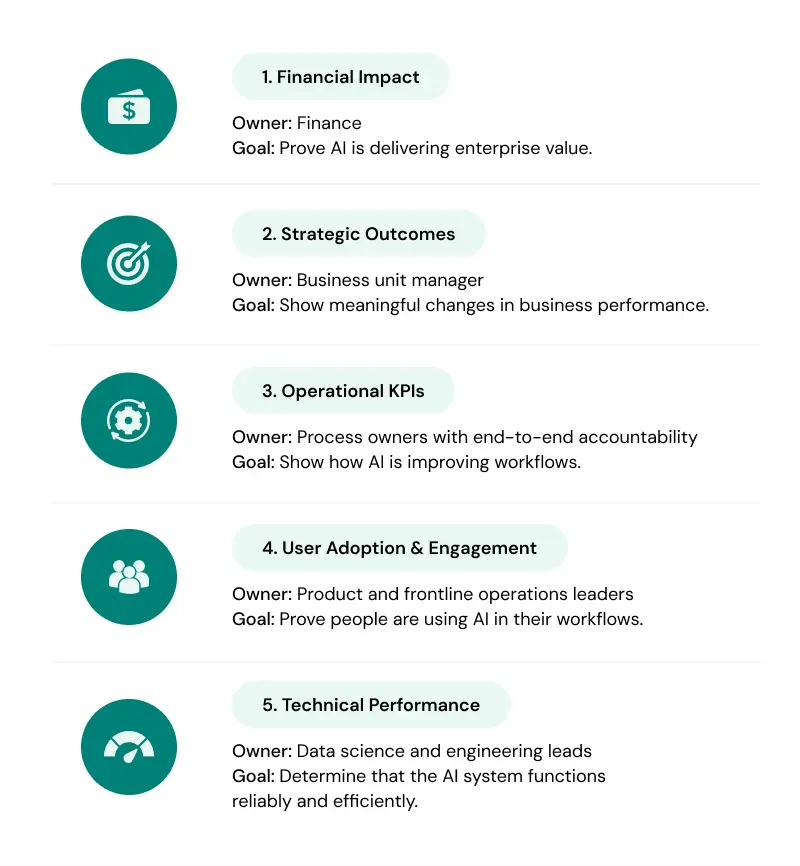
This framework is built from the bottom up, with technical performance creating the foundation.
Layer 5: Technical Performance
This layer monitors model health and guardrails to ensure the system is performing reliably and efficiently. It measures hallucination rates, token cost per interaction, response latency, and output quality. While this layer monitors the health of an AI system and is essential for reliable operation, these metrics alone are not sufficient to demonstrate business value.
Layer 4: User Adoption and Engagement
Adoption and engagement metrics indicate whether people are using and trusting the AI to support their daily work. They measure daily active users, workflow penetration, and AI acceptance rates versus overrides. It’s critical information because if adoption is low, deployments quietly fail. A capable model that is not embedded in real workflows creates no downstream impact.
Layer 3: Operational KPIs
These key performance indicators show whether AI is improving how work gets done by tracking cycle times, defect rates, cost per case, and first-contact resolution. If these metrics are flat, the AI’s not impacting how the business operates.
Layer 2: Strategic Outcomes
These metrics capture broad progress against business-unit goals in areas like customer satisfaction and retention, operational performance, support and service team effectiveness, and sales growth. This data helps business leaders connect daily operations to long-term impact.
Layer 1: Financial Impact
This is the layer that demonstrates the AI’s measurable value to those who hold the purse strings. High-efficiency companies determine what they expect this value to be at the outset, before the implementation starts. They look for expected revenue uplift, cost-to-serve reductions, and improvements in operating margins, and they examine the total cost of ownership. When they can get a holistic view of the benefits and costs and like what they see, they loosen the purse strings for expansions and improvements to the system.
Initiatives Stall Without Measurement
Most AI initiatives fail because the value cannot be proven when it matters, at the point where someone must decide whether to fund the next phase.
In Taazaa’s delivery experience, the most consistent gap is not at Layer 1 (financial impact) or Layer 5 (technical performance); both are usually defined before a project begins.
The gap is often at Layer 3 (operational KPIs). Organizations define financial targets and track technical metrics but leave the operational measures (cycle time, error rate, cost per case) unowned and unmeasured.
Without Layer 3, there is no causal chain connecting what the system does to what the business achieves. Layers 1 and 2 become aspirational rather than evidential.
Four Phases from Pilot to Scale
McKinsey’s framework maps to four deployment phases, each with a different measurement focus.
Pilot. A tightly scoped test with a small user group, focused on proving technical and practical feasibility. The measurement goal at this stage is credibility, not impact: does the system perform reliably, do early users engage with it, and does the original business case still hold given what the pilot revealed?
MVP. The solution enters real workflows with limited but live exposure. Measurement is now built into the tool rather than pulled manually. Dashboards track technical performance, user behavior, and early workflow impact automatically. Human-in-the-loop safeguards are explicitly defined at this stage.
Initial scaling. The phase where most AI programs either prove their case or stall. Adoption extends beyond early enthusiasts, operational improvements become statistically significant, and financial benefits at least offset total cost of ownership. If ROI is not evident here, the organization should refine its approach or stop the project before committing to a full-scale investment.
Full scale. The deployment moves from initiative to business as usual. AI is embedded in standard workflows, governance, and budgeting cycles. The measurement framework becomes part of ongoing performance management rather than a project deliverable.
What Measuring the Right Things Produces
Taazaa built Civi for the City of Dublin, Ohio, an AI tax-processing platform designed around a specific operational failure: municipal auditors were spending thousands of hours on manual data entry while quarterly revenue deadlines were missed and returns were approved without substantive review.
The measurement architecture was defined before the build began, with a designated owner for each layer.
- Layer 5: 80-85% extraction accuracy was achieved across more than 50 tax field types and is maintained by the engineering team.
- Layer 4: Auditors actively used the platform for review rather than routing around it, and this was tracked by the product team.
- Layer 3: Processing time was reduced from days to hours and is owned by the tax director.
- Layer 2: Quarterly revenue deadlines were met, and compliance was maintained, owned by the city’s finance leadership.
- Layer 1: Cost per return processed was reduced and staff hours were redirected from data entry to substantive audit work, owned by finance.
When the results were reviewed, every layer had evidence. The business case did not need to be rebuilt because the measurement architecture was built alongside the product. Working closely with the client, we defined measurement before beginning the build, designed attribution into the deployment, and assigned ownership to every layer.
The gap between AI activity and AI impact is not closed by better models. It’s closed by treating measurement as a design requirement rather than a reporting task.
For organizations building the governance and orchestration infrastructure that enables measurement at scale, Taazaa’s guide to AI agent orchestration covers the control layer that makes every agent action observable, attributable, and traceable to a business outcome.
Learn more about Taazaa’s AI delivery model and how we close the gap between what your AI is doing and what it is delivering.
Frequently Asked Questions
Why do most AI programs fail to prove ROI?
Because measurement is treated as a reporting task rather than a design requirement. IBM found only 29% of executives can confidently measure AI ROI despite 79% seeing productivity gains. The value exists, but the connection to business outcomes was never designed in.
What is the pilot trap and how do organizations avoid it?
The pilot trap is the pattern of releasing endless AI pilots without scaling any of them, because the evidence required to justify scale was never built. Organizations avoid it by defining a measurement architecture before deployment, building attribution into the rollout, and establishing explicit decision gates that projects must pass before receiving further investment.
Why does attribution need to be designed before deployment rather than after?
Because the baseline, control group, and data tagging required to attribute impact cannot be established retroactively. Organizations that defer attribution consistently find they cannot prove causation; the AI was running during the period in question, but whether it caused the improvement is impossible to determine after the fact.
What separates organizations that scale AI from those that stall?
McKinsey’s analysis identifies three practices that consistently advance programs to scale: defining value and linking metrics before deployment, building measurement and attribution into rollout, and running AI as a managed investment with a fixed review cadence and clear stage gates.