.webp)


Key Takeaways
- An agent is a model plus a harness; the gap between successful and failed AI deployments is often the harness.
- Harness components fall into two categories: guides that steer agent behavior before it acts, and sensors that catch problems after it acts.
- At enterprise scale, the harness becomes the shared platform layer that every team's agents inherit.
- Most harness failures can be traced to five predictable mistakes: system prompts as the only control, no verification loop, over-broad permissions, no persistent memory, and never revisiting the harness as the scope expands.
In the software engineering world, “harness” has become a catchall term for everything that surrounds an AI model to make it agentic.
For some, a harness is the set of tools and practices used to keep AI agents in check. For others, it describes the orchestration layer that connects the AI agent to the organization’s systems, data, workflows, and people it needs to accomplish its goals.
Naturally, this has led to some confusion when talking about harness engineering.
What Is a Harness?
At Taazaa, we defined a harness as everything built around a model that helps it be self-correcting and therefore agentic.
By themselves, models only take text inputs and return text outputs. They can’t maintain state across steps, execute code, touch live data, or enforce a permission boundary. For every useful thing an agent does, the harness does the heavy lifting.
OpenAI's harness engineering write-up demonstrates what this looks like at scale: a team that built and maintained a real product of over one million lines of code using no manually typed code at all, over five months, by investing in the harness rather than the model. Their conclusion: "Our most difficult challenges now center on designing environments, feedback loops, and control systems."
The Three Layers of a Harness
The overall implementation harness consists of three separate harnesses: a coding harness, a user harness, and an org-level harness. These harnesses sit inside one another like nesting dolls, with the model at the center.
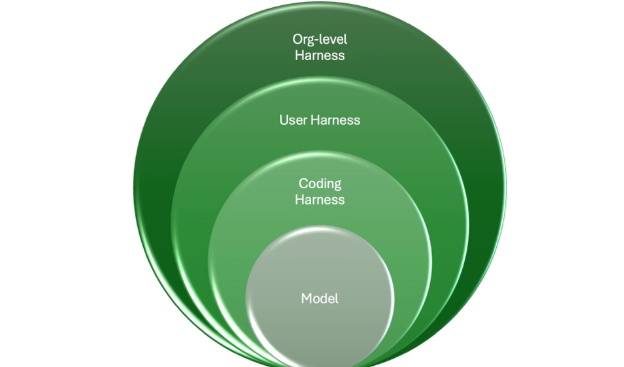
Each layer wraps the previous one, with different owners and different stakes.
The coding harness is the runtime built into the agent; e.g., the orchestration logic, tool use, sub-agents, context management, etc. It’s controlled by the SDK maker and inherited by every team that builds on it.
The user harness surrounds the coding harness. It’s made up of convention files, MCP server connections, custom skills, evaluation loops, system prompts, and review agents. This is where most practical engineering work happens.
The org-level harness is the outer layer; the shared platform governing agents across all teams. It includes a context lake (the shared, queryable organizational knowledge that every agent draws from), integration libraries, access controls, an agent registry, a workflow orchestrator, and a measurement infrastructure that tracks whether agents deliver value.
Without this outer layer, each team's agents operate on a partial, stale picture of the organization. Security reviews get repeated. Permissions get granted inconsistently. Mistakes compound across teams rather than being encoded once and fixed everywhere.
Guides and Sensors
Harness components fall into two categories based on when they act.
Guides act before the agent does anything. They steer it toward correct behavior with a system prompt, an architecture note, or a context file. A good guide raises the odds that the agent gets it right the first time.
Sensors act after. They catch what slips through, using a linter, a test suite, a review agent, or an evaluation loop. A sensor catching an error before it ships is worth more than the same catch made by a human reviewer after the fact.
A well-built harness uses both. Guides raise the probability of correct output. Sensors limit the impact of an incorrect output.
For organizations designing the architectural layer that makes these controls enforceable at scale, Taazaa's guide to agentic AI architecture covers the five core components that determine whether any harness holds under production load.
Harness Engineering Failure Patterns
Most harness failures follow five predictable, recurring patterns.
1. Treating the system prompt as the entire harness. A system prompt is one guide. Careful prompt writing does not substitute for actual tool schemas, permission boundaries, or test suites.
2. Skipping verification. An agent whose output is never checked by a sensor will eventually produce something that should not have shipped. The longer it goes undetected, the more expensive the correction.
3. Over-permissioning for convenience. An agent granted broad access because scoping it down takes extra setup is an agent that can do more damage than its task requires.
4. Failing to build persistent memory. A mistake caught last month will recur this month because nothing encoded the fix where the agent would see it again.
5. Never revisiting the harness. Controls built for a small task tend to stay in place as the agent's scope quietly expands from drafting text to touching real systems.
What Harness Engineering Looks Like in Practice
An example of harness-first engineering applied to a production AI workflow: Taazaa built Safeguard AI for a mortgage field services company using a Plan-and-Execute architecture.
The platform processes vendor work orders through six defined stages in sequence. Each stage has explicit permission boundaries, the agent accesses only the data and systems its specific task requires. Role-based access controls are enforced at the infrastructure layer. Every state transition and tool call is logged immutably. A human approval checkpoint governs any action exceeding defined risk thresholds.
The guides define what the agent can do and the sequence in which it can do it. The sensors (audit logs, permission checks, and human approval gates) ensured that what happened could be inspected, traced, and corrected. The result was an 80% reduction in payment cycles and 98.24% accuracy compared to human audits.
For organizations building the evaluation infrastructure that makes harness discipline measurable, Taazaa's guide to agentic AI evaluation covers the three-level evaluation framework that reveals harness failure modes before they reach users.
The Organizational Layer Most Enterprises Skip
Internal teams can build good user-level harnesses. The layer that often gets skipped is the organizational harness, the shared platform making the same discipline available to every team without every team rebuilding it from scratch.
Will harnesses become the new service templates? Service templates gave teams a starting point for encoding organizational standards that any team could inherit and extend. The org-level harness does the same thing for agents: shared integrations, consistent permission models, a context lake, and measurement infrastructure that answers the question of whether the fleet of agents across the organization is actually working.
McKinsey's State of AI 2025 found 88% of organizations use AI in at least one function, but only 6% qualify as high performers who can attribute meaningful business impact. The distance between 88% and 6% is, in large part, a harness problem. Most organizations are running models. Few are running governed, integrated, measurable systems.
The organizations bridging that gap treat the harness as infrastructure, built once at the organizational level and inherited by every team, rather than as a one-time engineering task for each individual deployment.
Taazaa's framework for AI design patterns covers the pattern-level decisions that determine how individual harnesses should be structured for specific workflow types, and which failure modes each pattern is designed to prevent.
The Implementation Layer That Connects AI to Outcomes
Harness engineering builds the implementation layer, the connective mesh between AI capability and business execution. It connects AI models to enterprise data, workflow logic, governance frameworks, and human operations.
Everyone has access to the same AI models, so organizations won’t gain a competitive advantage from the model they select. That’s delivered by the harness that makes the model reliable, auditable, and scalable across the enterprise.
The organizations building that harness now are the ones whose AI investments will generate returns. The ones deferring it are accumulating technical and governance debt that will become harder to pay down as agent proliferation accelerates.
Contact Taazaa to build the harness engineering foundation, organizational governance, and implementation layer that makes enterprise AI work at scale.
Frequently Asked Questions
What is harness engineering?
Harness engineering is the practice of building everything around an AI model that the model cannot do on its own: tools, state, execution, context, and controls. An agent is a model plus a harness, and the harness is usually the deciding factor in how reliable an agent turns out to be.
What is the difference between a model and a harness?
The model provides reasoning. The harness provides everything else: tools, permissions, state management, verification, and memory. Two teams running the same model will get different results, and the gap is almost always the harness.
What are guides and sensors in harness engineering?
Guides act before the agent acts, steering it toward correct behavior through system prompts and architectural constraints. Sensors act after, catching problems before they ship through test suites and review agents. A well-built harness uses both.
What is the org-level harness and why does it matter?
It is the shared platform layer governing agents across all teams: a context lake, shared integrations, access controls, an agent registry, a workflow orchestrator, and measurement infrastructure. Without it, each team rebuilds the same controls inconsistently, and mistakes compound across the organization.
What are the most common harness engineering mistakes?
Treating the system prompt as the whole harness, skipping verification, over-permissioning for convenience, building no persistent memory, and never revisiting the harness as agent scope expands.