


Key Takeaways
- Gartner predicts 40% of enterprise applications will include AI agents by the end of 2026, up from less than 5% in 2025.
- Nearly half of agentic AI projects will be canceled by the end of 2027 due to inadequate risk controls and unclear business value.
- 57% of teams now have agents running in production, according to LangChain's 2026 State of Agent Engineering report.
- The five agentic AI design patterns with the strongest production track record are ReAct, Reflection, Plan-and-Execute, Tool Use, and Multi-Agent Orchestration.
- Pattern selection, not model capability, is the primary driver of whether an agentic AI system scales.
Most agentic AI projects fail in production due to a missing architectural layer.
The model performs well in the pilot, with a limited number of users, APIs, and systems to interact with.
In production, however, the AI lacks the support it needs to handle concurrent users, edge-case inputs, tool failures, and inconsistent data. Drift begins to creep in, and outputs become less accurate. Trust in the system falters.
When this happens, most teams point their fingers at the AI model, or say AI overall isn’t mature enough to handle the business’s complexities.
In reality, what’s often missing is the architecture that surrounds and connects the AI to the organization’s systems, workflows, processes, and people.
What Are Agentic AI Design Patterns?
Agentic AI design patterns are reusable architectural approaches that determine how an agent reasons, acts, remembers, and recovers from failure. They shape how an agent breaks down goals, selects tools, corrects errors, and coordinates with other agents.
Selecting the wrong pattern for a given workflow is a common reason agentic AI pilots fail to scale. Getting it wrong early creates compounding problems that grow harder to fix as the system expands.
Five Agentic AI Design Patterns That Work
The graphic below is an overview of five design patterns, their use cases, and their production failure modes.
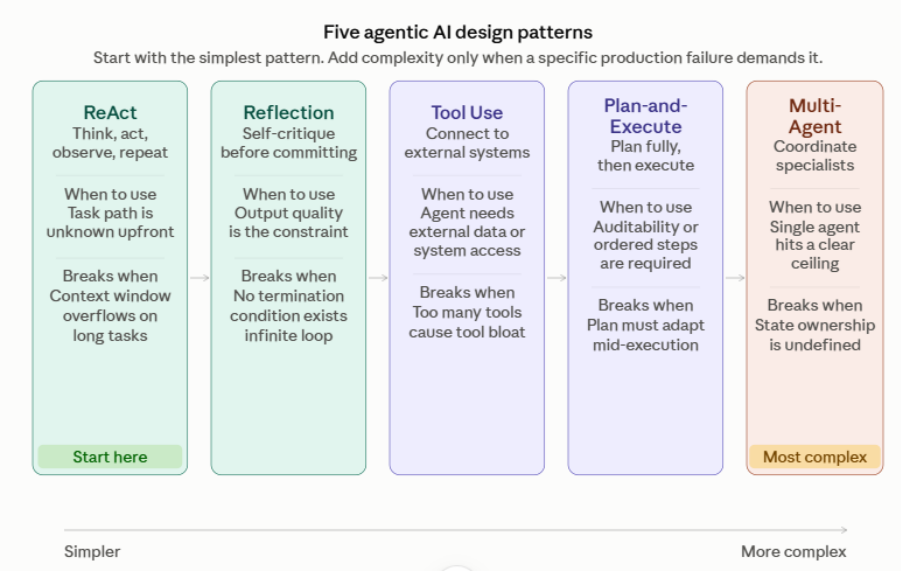
Let’s take a closer look at each pattern.
ReAct
ReAct, which is short for Reasoning and Acting, is the baseline pattern for most single-agent deployments. The agent thinks, acts, observes the result, and repeats until the task is complete.
Microsoft Azure identifies ReAct as the entry point for enterprise agentic deployments. An IT support agent can diagnose issues in real time, check system logs, test solutions, and adjust its strategy as new information arrives, all within the ReAct loop.
The pattern works well when tool interfaces are stable, and the task scope is bounded. It breaks when the task scope is unbounded or when tool failures are not explicitly handled.
Reflection
Reflection adds a self-critique layer before an agent commits to an output. After producing an initial response, the agent evaluates it against defined quality criteria and revises it before acting.
This is a risk reduction pattern. The production use case is any workflow in which an incorrect output cascades downstream before a human catches it: code generation, financial document drafting, compliance classification, clinical documentation, and similar use cases. The cost is latency. The benefit is catching errors before they reach production.
Plan-and-Execute
Plan-and-Execute separates planning from execution. The agent produces a complete plan first, a sequence of steps with explicit dependencies, then executes each step in order.
An example of this pattern is Taazaa's Safeguard AI deployment for a mortgage field services company. The platform processes vendor work orders through six defined stages in sequence: image classification, damage detection, code evaluation, bid assessment, inspection staging, and payment processing. Because the execution path was designed before any agent ran, the compliance team could inspect exactly what happened at every step. The result was an 80% reduction in payment cycles and 98.24% accuracy compared to human audits.
Plan-and-Execute is the right choice when auditability or predictable execution order matters, particularly in regulated environments.
Tool Use
The Tool Use pattern connects agent reasoning to external systems: APIs, databases, CRM platforms, ERP systems, and communication tools. It is a required component of almost every production agentic deployment.
The most common production failure mode is tool bloat. Google Cloud's architecture guidance identifies tool bloat as the result of giving an agent more tool definitions than it can effectively reason across. Accuracy drops, and latency rises. The mitigation is structural: limit each tool to fewer than five parameters, expose only the tools a specific agent needs, and log all tool invocations at the infrastructure layer.
Multi-Agent Orchestration
Multi-Agent Orchestration coordinates specialized agents under an orchestrator that decomposes goals and delegates them to the appropriate agent. According to LangChain's 2026 State of Agent Engineering report, 57% of teams now have agents running in production, with multi-step, multi-agent workflows representing the fastest-growing deployment category.
When a single agent reaches its performance limit, tool-selection errors multiply, latency increases, and the agent loses coherence. Splitting responsibilities across specialists, each reliable at a narrow task, produces a more reliable system than any individual agent could be alone.
For inter-agent communication, the Agent2Agent (A2A) protocol enables agents to communicate across different platforms and frameworks regardless of underlying technology. It complements Model Context Protocol (MCP); the MCP handles agent-to-tool, A2A handles agent-to-agent.
For organizations designing the orchestration infrastructure that makes these patterns enforceable at scale, Taazaa's guide to building an agentic AI architecture covers the five core components that determine whether any pattern holds up under production load.
How Patterns Combine
Production systems rarely use a single pattern. The most reliable enterprise deployments layer patterns deliberately, with each layer addressing a specific failure mode.
The most effective sequence for deploying these layers is to start with a single-agent ReAct system and add patterns to address business needs. For example, add Reflection when output quality is a constraint, or add Plan-and-Execute when auditability matters. Layer in Tool Use when external access is required, and graduate to Multi-Agent Orchestration only when a clear capability ceiling emerges.
Adding multi-agent complexity too early is the most common architectural mistake in enterprise agentic deployments.
What Breaks Patterns in Production
Understanding why patterns fail matters as much as understanding how they work.
Context window overflow breaks ReAct agents on long tasks. As observations accumulate, earlier context gets dropped, and the agent loses coherence. Explicit context management must be designed in before this limit is reached.
Reflection without a termination condition creates infinite loops. Every Reflection implementation needs an explicit exit: a maximum number of revision cycles, a quality threshold, or a confidence score above which revisions stop.
State ownership ambiguity breaks multi-agent systems. When two agents can write to the same downstream record, the result is either corrupted output or a deadlock. State ownership must be assigned to exactly one agent per resource before deployment.
Tool permission creep is the silent failure in Tool Use deployments. As workflows expand, agents incrementally accumulate permissions. Regular permission audits are required to prevent creep.
Memory poisoning affects multi-agent systems sharing a memory layer. When one agent writes incorrect information to shared memory, downstream agents inherit and propagate the error. Establish explicit write permissions scoped to each agent and task context to prevent this.
For organizations building evaluation infrastructures that expose these failure modes, Taazaa's guide to evaluating agentic AI in production covers the three-level evaluation framework that makes production failure modes detectable before they compound.
Three Decisions Before Deployment
According to Gartner, 40% of agentic projects will be canceled by end of 2027. The organizations that succeed with agentic AI make three decisions before their first production deployment.
First, they select the pattern before selecting the model. The pattern determines the cognitive architecture. The model fills a role within it.
Next, they define failure modes for each pattern in use. Every pattern has documented production failure modes. Knowing them before deployment is the prerequisite for systems that recover gracefully.
Finally, they start with minimum pattern complexity. Add patterns when a specific failure mode demands them. Never add them speculatively.
Although it may seem simple to make these three decisions, many internal teams consistently underestimate the integration complexity, governance requirements, and evaluation discipline it takes to build a production-grade agentic system. Their inexperience leads to issues that crop up mid-project, when reversing course is expensive.
For organizations building the governance foundations that make these decisions executable, Taazaa's guide to laying agentic AI foundations covers the observability and access control requirements that determine whether any design pattern can scale to production load.
Optionally, an experienced technology partner like Taazaa. We help your team design and deploy agentic AI systems with the right patterns, governance frameworks, and evaluation infrastructure. Contact Taazaa today to book a strategy session.
Frequently Asked Questions
What are agentic AI design patterns?
Agentic AI design patterns are reusable architectural approaches that determine how an agent reasons, acts, remembers, and recovers from failure. Pattern selection, not model capability, is the primary driver of whether an agentic AI system scales or stalls in production.
What is the difference between ReAct and Plan-and-Execute?
ReAct adapts step by step: the agent thinks, acts, and adjusts based on what it observes. Plan-and-Execute produces a complete, inspectable plan before any action is taken. ReAct suits open-ended tasks. Plan-and-Execute suits regulated environments where auditability matters.
When should multi-agent orchestration be used?
Multi-agent orchestration should be used when a single agent hits a clear capability ceiling: tool selection errors multiply, latency grows, or the agent loses coherence on the overall goal. However, adding multi-agent complexity before hitting that ceiling introduces coordination overhead with no corresponding benefit.
What is the Reflection pattern?
The Reflection pattern is a self-critique layer where the agent evaluates and revises its own output before committing. It reduces the risk of incorrect outputs cascading downstream. Every Reflection implementation needs an explicit exit condition to prevent infinite revision loops.
What breaks agentic AI patterns in production?
Context window overflow breaks ReAct. Missing termination conditions break Reflection. State ownership ambiguity breaks multi-agent systems. Tool permission creep breaks Tool Use. Memory poisoning corrupts systems sharing a memory layer. Knowing these failure modes before deployment separates production-grade systems from extended pilots.




.webp)