.webp)


Key Takeaways
- Three stages define AI adoption maturity: AI-assisted (individual productivity), AI-enabled (team and process productivity), and AI-first (organizational redesign).
- AI-native organizations are built around AI from the beginning. Most organizations run on legacy systems and non-AI technologies, making AI-native a difficult goal.
- Becoming AI-first requires deliberately deciding where AI adds value, what it should own, and where people remain the better choice.
- Teams in AI-first organizations work differently from those in traditional organizations.
Many business organizations seek to scale their AI solutions across the enterprise, with the ultimate goal of becoming “AI-native.”
The leaders of these organizations see AI-native as the top of the pyramid of AI maturity.
But for existing organizations with legacy systems built before the AI boom, becoming AI-native is a very difficult and expensive goal. And it’s probably not what these business leaders really need.
For established enterprise-level organizations, becoming an AI-first organization is the true transformation they’re looking for.
AI-Native vs. AI-First: Why the Distinction Matters
An AI-native organization has AI built into its foundations from the start. Its products, operating model, and technology architecture have AI in their DNA. These businesses were started in the last few years by innovators who saw how AI could be applied in a unique way to a specific business problem. Companies like Snapform AI and Civi are examples of AI-native organizations.
Being newer, these organizations don’t have to transform the legacy systems, SaaS platforms, and other older technologies that established companies run on. These systems can’t be redesigned from the ground up without a massive level of effort, downtime, and cost.
An AI-first organization, however, doesn’t need to have been built around AI. It deliberately redesigns its strategy, workflows, and operating model to take advantage of what AI can now do, starting where the value is clearest and building from there.
Three Stages of AI Adoption Maturity
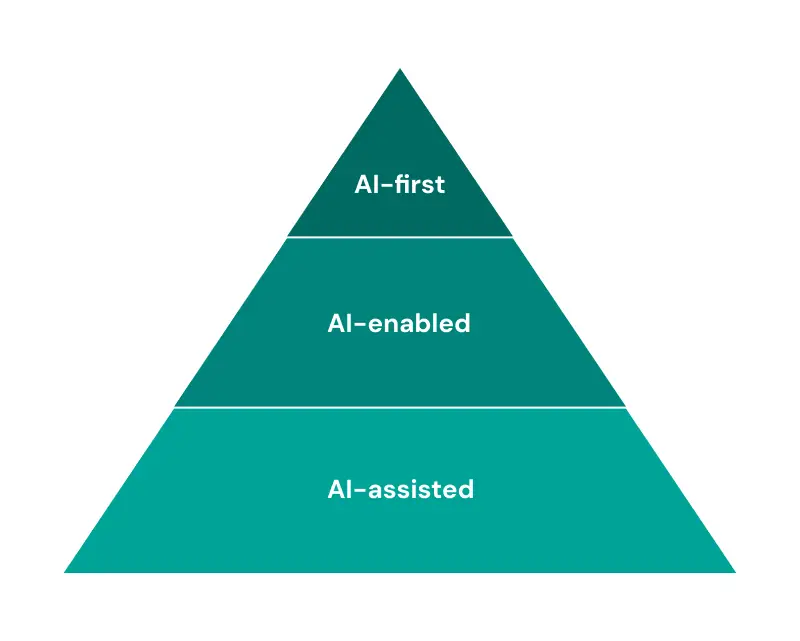
For established enterprises, then, the AI maturity pyramid looks like this:
AI-assisted
AI-assisted organizations use AI within their existing workflows to help individual employees be more productive. A salesperson generates proposals faster. A developer writes boilerplate code more quickly. A customer service agent summarizes tickets before responding. These are real improvements, but they do not change how the organization makes decisions, designs products, or structures work.
AI-enabled
AI-enabled organizations embed AI in department-wide or company-wide processes to improve an entire team’s productivity. A customer service team handles more volume with the same headcount. A finance team closes the books faster because reconciliation is partially automated. The process has changed, not just the speed at which people execute it.
AI-first
AI-first organizations focus on improving organizational productivity. They transform their products, workflows, and strategies around the combination of humans and AI. Decisions are made differently. Roles are redefined. The boundary between human work and AI work is drawn deliberately, not assumed.
McKinsey's State of AI in 2026 survey shows that “AI high performers” (the organizations that attribute at least 5% of EBIT to AI and describe its value as “significant”) are 3.3 times more likely than others to intend to fundamentally transform their business with AI within three years. Nearly three-quarters of these AI-first companies have fundamentally redesigned their workflows because of AI use, up from 55% the year before.
By contrast, only one-quarter of other organizations report the same.
How Do AI-First Teams Differ?
Teams in AI-first organizations work differently from those in traditional organizations.
Focused on Human Judgment
AI-first teams focus human work on deciding what to delegate to AI, evaluating outputs, and intervening when the AI needs to be corrected. In practice, developers on AI-enabled projects spend less time writing routine code and more time designing the decision points, approval flows, and controls that govern what the AI does.
Leveraging Expanded Capabilities
AI-first organizations enable people to expand their capabilities. Rather than focusing on a single area of expertise, employees can simultaneously develop real functional capabilities across several adjacent disciplines, with AI enabling them to do tasks they otherwise couldn’t. We recently had one of our UX/UI designers build a functioning AI chatbot, for example. We’ve had product managers create entire websites. AI flattens the learning curve.
Creating AI-consumable Context
AI-first teams treat context as an engineered asset. AI can’t consume knowledge that’s contained in disparate documents, systems, and people's heads. Organizational knowledge must be structured and accessible to both AI systems and people.
Seeing AI as an Assistant
AI-first teams recognize that agentic AI is more of an assistant than a tool. Agentic systems can use external tools and interact with other systems to complete complex tasks. This means AI can perform the work, and people can manage the outcomes.
Ensuring Error Detection and Recovery
At the same time, AI generates moves faster and generates more output than people can keep up with. This results in greater exposure to the risk of mistakes. AI-first teams put control measures in place to quickly detect errors and mitigate their impact, such as automated testing, continuous integration, and observability. These practices become even more important for maintaining quality.
Sharing Feedback
As individuals on the team interact with AI, they learn what works, what’s missing, and where the failure points are. AI-first teams capture and share this information, so that it can be used to improve instructions, context structures, and workflow designs.
Four Organizational Capabilities That Make It Scale
Creating an AI-first enterprise requires four shared foundations, drawn from documented patterns in AI-first delivery practice.
Clearly Communicate AI Policy
Everyone should have a clear understanding of how AI is expected to be used across the organization, where its use is restricted, which decisions it can handle, and where human accountability remains essential. Most existing operating models were designed with people as the primary actors. An AI-first operating model can make these boundaries clearer by defining where AI can act autonomously, where people remain involved, and how responsibility is shared between them.
Make Data AI-ready
Access to reliable internal data, documentation, code, and business context is necessary for AI to work at scale, but simply making more data available isn’t enough. To use information well, AI systems also need it to be high-quality, well-structured, and thoughtfully governed. A task that seems simple to a person may require an agent to consume a large number of tokens.
Taazaa encountered this pattern directly in building Civi for the City of Dublin, Ohio. The city's existing tax portal and filing infrastructure were functional, but designed for human auditors, not AI agents. Rather than replacing those systems, Taazaa built an intelligent processing layer between document intake and the downstream systems already in place. The AI achieved 80-85% extraction accuracy, reduced processing time from days to hours, and enabled Dublin auditors to focus on substantive tax review rather than manual data entry. Getting to that outcome required understanding the data architecture before writing a line of agent code, not after.
Establish Strong Engineering Practices
Automated testing, observability, continuous delivery, and reversible changes allow organizations to safely experiment with AI without sacrificing reliability. Gartner research found that organizations with strong engineering foundations move significantly faster with AI adoption because they have the mechanisms to validate and control change at scale.
The Taazaa team applied this principle when building the Taurex Trading Coach. The original architecture had three-minute response times that made the product unscalable. Taazaa rebuilt it with a strict separation of concerns: a deterministic dbt layer handles all mathematical computations, and the LLM performs no math at all. It translates structured analytics into plain-language coaching. Every number in the coaching report is auditable and reproducible. The result was latency dropping from 148 seconds to 22 seconds, and token usage falling from 50,000 per request to 6,000-8,000. The engineering discipline that made the product reliable is the same discipline that made it scalable.
Focus on the Customer’s Problem
AI can help teams build software faster, but speed only matters if they’re solving the right problem. Clear customer outcomes offer a helpful North Star for deciding where AI can (and can’t) make a difference.
Develop Internal AI Platforms
Internal platforms can give everyone easier access to AI capabilities while maintaining guardrails for models, data, tools, and permissions. When properly designed, they make the safe path the simplest one to follow. As systems become more agentic, platforms also need to help manage what agents can access, what they can do on their own, and when human involvement is needed.
Deloitte's 2026 State of AI research found only 21% of companies have a mature governance model for AI agents. That gap is the most consequential difference between organizations that stay AI-assisted and those that reach AI-first. Governance is not what slows the transition. The absence of governance is what prevents it.
Where Most Organizations Are Stuck
Most organizations are stuck between being AI-assisted and AI-enabled. They’re deploying tools team by team and workflow by workflow, without the shared foundations that allow individual successes to compound into organizational transformation.
The organizations making the transition from AI-assisted to AI-first are the ones that answer the foundational questions deliberately, before scaling: where does AI add value in this specific process, what does the process need to look like to support that, where do people stay in control, and what governance infrastructure needs to exist before the first agent runs in production.
Before Taazaa builds any AI-enabled system for a client, five questions determine the design: what result are we trying to create, how does that work get done today, what information does it rely on, where can AI help, and where do people stay in control. The answers shape the workflow architecture, the data requirements, and the governance infrastructure before any code is written. This sequencing is what determines whether the first deployment becomes the foundation for organizational AI or remains an isolated pilot.
For organizations working through this transition, Taazaa's guide to building process-specific AI agents covers the deployment patterns that produce measurable ROI at the workflow level, the starting point for organizations moving from AI-assisted to AI-enabled.
For help with becoming an AI-first organization, contact the experts at Taazaa.
Frequently Asked Questions
What is the difference between an AI-native and an AI-first organization?
An AI-native organization was built around AI from the start. An AI-first organization deliberately redesigns its workflows and operating model to leverage AI without requiring a ground-up rebuild. For most established enterprises, AI-first is a more realistic and valuable goal.
What are the three stages of AI adoption maturity?
AI-assisted (AI supports individual tasks), AI-enabled (AI is embedded in team workflows and processes), and AI-first (organizations redesign products, processes, and operating models around what humans and AI accomplish together).
What does it mean for human roles in an AI-first organization?
Human roles shift from execution toward judgment: deciding what to delegate, evaluating AI outputs, and determining when intervention is required. The work does not disappear; it moves to a more architectural level.
What is the most critical foundation for scaling AI across an enterprise?
A clear AI stance and governance model. Deloitte's 2026 research found only 21% of organizations have a mature governance model for AI agents. Without it, different teams make different assumptions, creating inconsistency, risk, and investments that do not compound.