


Key Takeaways
- 82% of senior leaders are concerned about AI token costs, and 98% say those costs have caused them to reconsider their approach.
- 87% of financial services organizations have deployed or are piloting in-house AI-built software, yet returns remain concentrated at the function level.
- In Q1 2026, 31% of new banking AI use cases were agentic, up from 15% the prior quarter.
- McKinsey projects net AI savings of 15-20% of total banking costs, despite gross cuts of up to 70% in some categories.
- Firms that connect enterprise intelligence to agentic execution consistently outperform those running isolated deployments across disconnected functions.
Financial services firms were among the first businesses to use AI seriously. Fraud detection, credit scoring, algorithmic trading, and risk modeling were all running machine learning before most industries had even begun experimenting with AI.
But with AI expenses rising, these investments are being put under a microscope.
EY’s AI Pulse Survey found that 82% of senior leaders are concerned about token usage and related costs, and 98% are reconsidering their approach to AI because of these costs. They’re seeing only modest gains in productivity and efficiency from their initial AI deployments, making it difficult for them to justify further investments.
To realize sustainable AI value at scale, finance firms need to build a unified enterprise AI that ties together their bots, apps, and agents.
Why Are Gains Isolated?
Typically, initial AI implementations are fragmented: the compliance team deploys a document review tool; the trading desk deploys a signal detection model; customer service deploys a bot for routine queries. Each one works reasonably well, but they aren’t integrated with each other.
Cambridge CCAF’s 2026 report found that 81% of companies have adopted AI at some level. In NVIDIA’s 2026 State of AI in Financial Services survey, 89% said AI has helped increase revenue or decrease costs. However, more than half of the CCAF respondents find it hard to measure AI’s financial impact at scale, even when individual teams can see value locally.
Fragmented AI delivery approaches solve narrow problems and deliver only modest value. To see a greater impact across the enterprise, firms need extensive coordination across organizational boundaries, something that takes a larger budget and more sponsorship.
Is the Token Cost Problem Really That Urgent?
It is, and it’s accelerating. As agentic AI adoption grows, token cost compounds. Evident Insights found 31% of new AI use cases in banking were agentic in Q1 2026, up from 15% the previous quarter. Each agentic interaction triggers multiple model calls, causing token usage in production to routinely exceed what pilot testing indicated it would be.
Strategic architecture planning can keep token usage manageable. We’ve found a robust AI architecture incorporates the following:
- Pre-computing deterministic outputs outside the inference loop before the model runs
- Routing each task to the lowest-cost model that delivers the required quality
- Caching reusable context rather than reprocessing it on every call
- Enforcing explicit controls on agent retry behavior and tool call volume before deployment
Taazaa applied these principles when rebuilding the Taurex Trading Coach, an AI coaching platform for a global retail brokerage. The original architecture sent all analytics via LLM calls, resulting in around 50,000 tokens per request. Taazaa introduced a deterministic pre-compute layer, in which all mathematical metrics are calculated in a daily pipeline, with the LLM receiving only structured outputs to translate into coaching language.
Token usage dropped 84-88%, from roughly 50,000 to 6,000-8,000 per request. Latency dropped from 148 seconds to 22 seconds. The economics changed entirely without switching to a different model.
What Does Enterprise-Level AI Require?
EY’s framework describes two capabilities firms must build together.
The brain is the enterprise intelligence layer, integrating data, policies, IP, market trends, and regulations into a unified layer agents can reason from. Work is triggered by signals (market intelligence, customer behavior, regulatory change) rather than by planning cycles. The brain grows smarter as it ingests more operational data, making continuous improvement a built-in property rather than a periodic project.
The muscle is the agentic execution layer, orchestrating agents, managing handoffs, approvals, and feedback across the entire delivery lifecycle. Agent libraries with specific roles (product development, engineering, compliance, insight generation) are invoked to execute work. Delivery signals flow back into the brain continuously, redirecting agents toward next-best actions.
Together, these support dual-speed transformation: incremental efficiency improvements in day-to-day operations running alongside accelerated innovation programs, both tracks establishing an AI-first operating model for the business.
Based on Taazaa’s reading of EY’s framework and its own delivery experience, three investments determine whether isolated gains compound into enterprise-wide value:
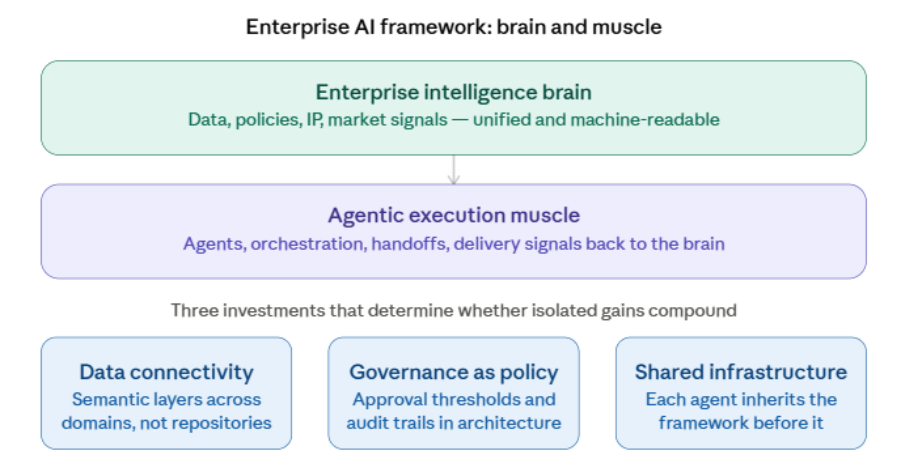
McKinsey’s 2025 Global Banking Annual Review projects net AI savings of 15-20% of total banking costs, with gross cuts of up to 70% in some categories, offset by rising technology costs. The gap between gross potential and net realization is precisely where these three investments operate.
What Does AI-First Software Delivery Mean?
Traditional development approaches will not be sufficient to scale AI or enterprise intelligence. EY’s AI Pulse Survey found 87% of organizations have already fully deployed or are piloting programs to develop in-house, AI-built software for internal organizational use.
This requires a fundamental change in IT’s role. Rather than building individual AI tools or managing individual agent deployments, IT’s responsibility is to establish the context, architecture, and platform foundations required to scale AI across the enterprise. That means:
- Designing canonical data models and knowledge architectures
- Defining agent architectures and reusable delivery patterns
- Developing plans for data modernization and integration
- Ensuring agents work through existing systems, not around them, including observability, incident management, and IT service management
This change requires a significant shift in data management, as well. Rather than centralizing data in large repositories, the new goal is connecting data across domains through semantic layers and ontologies that make it usable by agents. This is what makes the brain genuinely intelligent.
The Importance of FDEs
Some firms have used forward deployed engineers (FDEs) to support enterprise-level transformation initiatives. These teams have demonstrated the ability to tackle cross-domain business problems and establish a shorter, repeatable path to AI ROI.
The reason it works is practical. Engineers embedded inside a client’s actual environment find integration constraints, data quality issues, and compliance requirements before the build begins, rather than after the first production failure. The integration complexity in financial services is difficult to see from the outside.
For organizations evaluating how to sequence financial services AI deployment, Taazaa’s guide to forward deployed engineering covers what that role looks like in practice and what it takes to make it work in a regulated environment.
For organizations designing the orchestration infrastructure that connects enterprise intelligence to governed agent execution, Taazaa’s guide to AI agent orchestration covers the control-layer architecture required by regulated environments.
Contact Taazaa to design the enterprise intelligence architecture and governance framework that creates sustainable value from your financial services AI investments.
Frequently Asked Questions
Why has AI value in financial services been hard to realize at enterprise scale?
Because most deployments are isolated within specific functions and cannot benefit from shared data, governance, or organizational intelligence. EY found that grassroots delivery solves narrow problems and delivers only modest value; enterprise returns require the brain-and-muscle model operating across the whole organization.
What is the “brain and muscle” model EY describes?
The brain is the enterprise intelligence layer, integrating data, policies, IP, and market signals into a unified layer agents can reason from. The muscle is the agentic execution layer, orchestrating agents, managing handoffs, and delivering outputs triggered by business signals rather than planning cycles.
What is the token cost problem and how is it addressed?
As agentic AI adoption grows, token costs compound faster than pilots indicate. 98% of financial services leaders who use token-based tools say costs have prompted reconsideration. The architectural fix is to precompute deterministic outputs outside the inference loop, route tasks to the right model, and enforce controls on agent retry behavior before deployment.
Why does governance need to be in the architecture rather than the process?
Agents acting at speed cannot wait for human review at every step. Governance in system prompts is a behavioral suggestion. Governance at the infrastructure layer is an enforcement control that also generates continuous, automated audit evidence that regulators in financial services require.
What does forward deployed engineering offer?
Engineers embedded inside a client’s actual systems surface integration constraints and compliance requirements before the build begins. EY identifies this as a leading practice in financial services AI because it establishes a shorter, repeatable path to ROI in environments where external teams routinely underestimate what is there.