


Key Takeaways
- Prompt engineering addresses user input. It can handle simple tasks, but prompting alone can’t handle the complexity of production environments.
- Context engineering designs the information environment around the model, managing memory, retrieval, and tool access across complex workflows.
- Harness engineering builds the complete infrastructure surrounding an agent: constraints, feedback loops, observability, and control mechanisms that make AI reliable at scale.
- The three disciplines are not alternatives. Each is a subset of the next, and production systems need all three working together.
Most teams building AI systems start with prompt engineering and refine their prompts to improve the output.
They quickly find out that agentic systems need more than prompts to securely manage information flow, tool orchestration, and data access.
In fact, it takes three engineering disciplines to create an AI system that works reliably in production at the scale required by enterprise organizations. In addition to prompt engineering, development teams need to leverage context engineering and harness engineering.
Let’s look at how these three disciplines relate to combine to support production-grade agentic AI for the enterprise.
Prompt Engineering
Prompt engineering involves phrasing natural-language queries to generate the desired outputs from AI models.
It covers aspects such as instruction design, chain-of-thought prompting, few-shot examples, temperature settings, and output format directives. Prompt engineering is the fastest way to get value from a language model and the right tool for simple, bounded tasks, such as content generation, summarization, translation, and single-turn question answering.
The problem is fragility. Something as simple as reordering examples in a prompt can produce drastic shifts in accuracy. Changing an output instruction from "Output strictly valid JSON" to "Always respond using clean, parseable JSON," can cause structured-output errors that break downstream systems within hours. Prompts are hard to version, difficult to test systematically, and nearly impossible to standardize across teams.
In a single-turn context where occasional inaccuracy carries low business risk, prompt engineering is sufficient. In a production system handling customer records, financial data, or compliance workflows, it is not.
Context Engineering
Context engineering is about building a system to determine what information the model is allowed to access before it generates a response.
Where prompt engineering optimizes a single instruction, context engineering manages system-wide information flow across multiple turns. It includes:
- Memory management: What conversation history stays active, what gets summarized, and what is discarded.
- Retrieval pipelines: How relevant documents, records, and data are fetched dynamically and sequenced into the context.
- Tool orchestration: Which functions the model can call and how their outputs flow back into the context window.
- Output structuring: What formats responses must adhere to so downstream systems can consume them reliably.
The core constraint context engineering addresses is context rot. As token count increases, a model's ability to recall information accurately degrades. Context engineering curates the minimal viable set of high-signal tokens for each query, rather than feeding everything and hoping the model finds what matters.
Context engineering is what separates an impressive demo from a system that can maintain coherent, multi-step work over time. Without it, agents become forgetful, inconsistent, and unreliable in proportion to the task's complexity.
Harness Engineering
Harness engineering builds the complete infrastructure surrounding an AI agent: the constraints, feedback loops, orchestration layers, observability systems, and control mechanisms that transform raw outputs into a production-grade system.
Where prompt engineering operates at the instruction level and context engineering operates at the information level, harness engineering operates at the system level. It handles:
- Architectural constraints: Linters, structural tests, and validation gates that enforce boundaries mechanically rather than through instructions.
- State management: Persistence across sessions that exceed context limits, using summarization and external memory to maintain continuity.
- Feedback loops: Self-verification mechanisms that catch incorrect outputs before they propagate.
- Observability: Logs, metrics, and traceability for every agent action, decision, and tool call.
- Human-in-the-loop controls: Approval gates that enforce hard boundaries at high-risk decision points.
- Cost controls: Limits on token consumption and task loops that prevent runaway compute costs.
The relationship between the three disciplines is hierarchical, not parallel. Prompt engineering exists within context engineering. Context engineering exists within harness engineering. Each layer addresses what the one before it cannot.
The Harness Is the Performance Variable
The counterintuitive finding from recent AI agent research is that harness design produces larger performance differences than model selection.
LangChain's controlled experiments on Terminal Bench 2.0 found that holding the model constant while improving only the harness configuration raised task completion from 52.8% to 66.5%, a 13.7 percentage point gain from harness design alone.
The practical implication is that teams evaluating AI tools by comparing model capabilities are measuring the wrong variable. In production, the harness is the performance variable. A strong harness around a mid-tier model consistently outperforms a weak harness around a stronger one.
This is why OpenAI's harness engineering approach did not achieve the desired result through prompt refinement. Their own conclusion: "Our most difficult challenges now center on designing environments, feedback loops, and control systems."
Taazaa's guide to the AI agent harness covers the eight building blocks and seven failure modes that determine whether a harness holds up in production.
Where Each Discipline Fails Without the Next
Understanding where each discipline breaks down reveals why the hierarchy matters.
Prompt engineering fails at scale because prompts aren’t enforceable controls. A harness permission boundary is enforceable.
Context engineering fails without harness infrastructure because information quality degrades without governance. Stale retrieval results, conflicting memory states, and unchecked tool outputs all produce confident but incorrect answers. Without feedback loops and validation gates at the harness level, context failures are invisible until they cause a downstream incident.
Harness engineering fails without the others because a well-governed system with poor instructions and irrelevant context produces the wrong answer. All three layers must function correctly.
A Decision Framework: Which Discipline to Apply
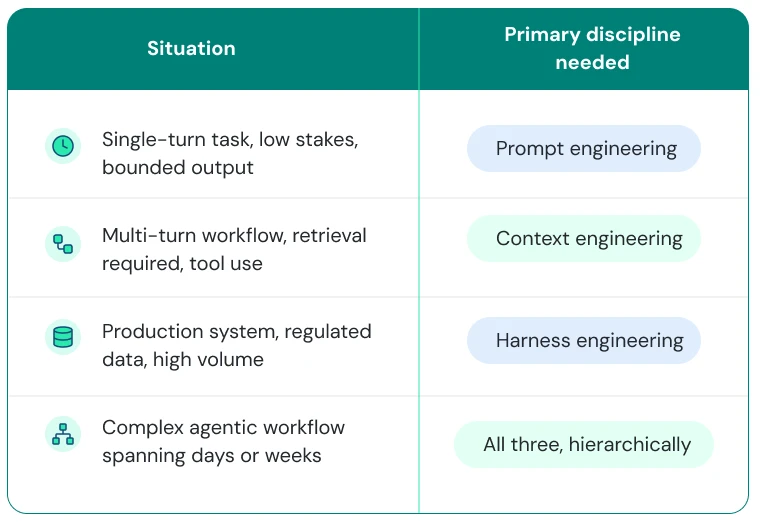
When building production systems, start with prompt engineering to establish baseline behavior. Add context engineering when the workflow requires memory, retrieval, or tool coordination. Add harness engineering before any agent touches production data, customer records, or compliance workflows.
For organizations mapping these engineering decisions to specific workflow architectures, Taazaa's guide to agentic AI design patterns covers the five most common production patterns.
What This Means in Practice
The organizations producing the most consistent returns from AI are not the ones with the latest or most powerful models. They are the ones that treat the harness as infrastructure, built once at the organizational level and inherited by every team's agents.
One example of what this looks like in production: Taazaa built Safeview for Safeguard Properties, a mortgage field services company, as a six-stage sequential harness covering image classification, damage detection, code evaluation, bid assessment, inspection staging, and payment processing.
Each stage was a discrete, independently maintainable layer. System prompts, tool definitions, feedback loops, guardrails, and observability infrastructure were each separated so that one layer could be updated without touching the others. When the quality threshold on damage detection was recalibrated mid-deployment, it did not require a full harness rewrite. It required changing one component.
The result for the client was an 80% reduction in payment cycles and 98.24% accuracy compared to human review.
The model contains the reasoning. The harness turns that reasoning into reliable work.
Learn more about Taazaa's AI engineering services.
Frequently Asked Questions
What is the difference between prompt engineering and context engineering?
Prompt engineering asks how to phrase instructions. Context engineering asks what information the model needs. Prompts optimize single interactions; context engineering manages memory, retrieval, and tool access across complex workflows.
What is harness engineering, and why does it matter more than prompting?
Harness engineering builds the infrastructure around an agent: constraints, feedback loops, observability, and controls. LangChain's Terminal Bench experiments found that improving only the harness configuration raised task completion from 52.8% to 66.5% with the same model.
Can prompt engineering alone work in production?
Rarely. Prompts are fragile: small wording changes can cause 40%+ accuracy shifts. They cannot enforce boundaries mechanically, handle failures, or maintain state across sessions. Production systems require context and harness engineering alongside prompting.
Are the three disciplines alternatives or do they work together?
They work together hierarchically. Prompt engineering falls under context engineering, which in turn falls under harness engineering. Production systems need all three: prompts craft instructions, context curates information, and harness enforces reliability.
Where should a team start when building a production AI system?
Start with prompt engineering to establish baseline behavior. Add context engineering for multi-turn workflows requiring memory and retrieval. Layer harness engineering before any agent touches production data, customer records, or compliance workflows.





.webp)