


Key Takeaways
- An AI agent harness is the software infrastructure around a language model: tools, memory, sandboxes, feedback loops, and guardrails that turn a model into a working agent.
- AI Agents consist of a model, the organization’s existing assets (data, workflows, systems, and people), and the harness that connects them.
- Most production agent failures trace to the harness, not the model. Context rot, tool overload, missing guardrails, and weak verification are the leading causes.
Most teams building AI agents focus on the most visible part of the system: the model.
It is also the wrong place to spend most of the engineering effort. The component that determines whether an AI agent works in production is the harness.
The harness acts as an implementation layer that connects your AI technologies with your existing data, systems, workflows, and people.
It’s challenging to build, but with a well-built harness, the AI agent can operate as successfully at production scale as it did in the pilot’s constrained environment.
What is an Agent Harness?
Taazaa defines an AI agent harness as the software infrastructure that wraps around a large language model, enabling it to perform tasks rather than just respond to prompts.
The model reasons through a problem and decides what to do next. The harness connects it to the tools, systems, data, and people needed to carry out those actions.
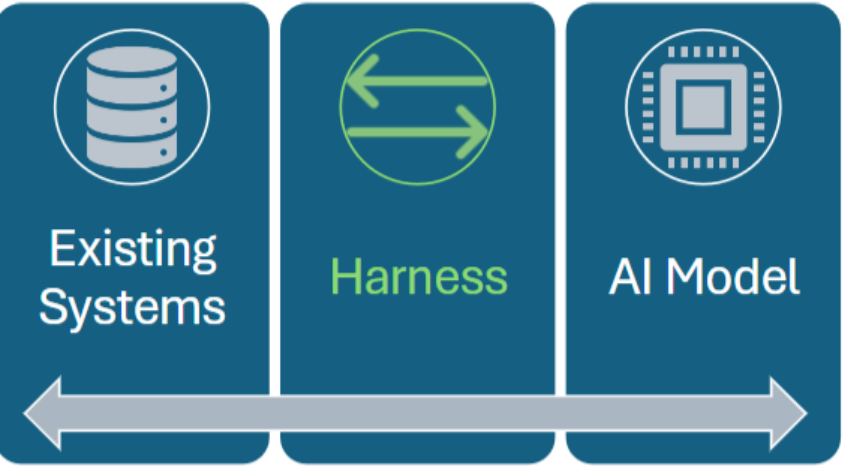
The model is kind of like a car's engine. The gas tank contains your systems, workflows, and data. Your people work the accelerator pedal. And the harness is all the wiring and fuel lines and such that connect it all into a working vehicle.
The harness design determines the outcome to create, what system produces, what data it needs, where AI can help, and where your people stay in control. It keeps the AI’s outputs consistent and governed.
Without a harness, a model can’t reliably run code, call APIs, access files, remember prior work, or complete multi-step workflows on its own.
The ReAct Loop
The ReAct loop (short for Reason and Act, not the mobile app development framework) is the foundation of most agentic AI systems right now.
In a nutshell, the ReAct loop works like this:
- A user sends a request or query to the agent.
- The agent reasons about the data it has and the data it needs to provide an accurate response.
- It then acts by calling the tool or tools it needs to retrieve the missing data.
- Once the called tools return the data to the AI, the model observes the result, adding it to its context about the query.
- It then returns to Step 2 and repeats the loop until it determines that it has enough information to accurately answer the user’s request.
- The loop ends, and the model sends the response to the user.
The harness carries out the actions: running tools, executing code in a sandbox, calling an API, writing to storage, and any other actions needed. It also captures the result and feeds it back to the model as new context.
Every step where the model decides what to do is a model function. Every step where something happens is a harness function. The loop cannot run without both.
Taazaa's guide to agentic AI design patterns covers the ReAct pattern alongside Reflection, Plan-and-Execute, Tool Use, and Multi-Agent Orchestration, and the specific production failure modes each pattern is designed to prevent.
Eight Building Blocks Every Production Harness Needs
Most production harnesses are built from the same foundational components, each solving a different limitation of the raw model.
System prompts give the model its standing instructions, such as what it’s trying to accomplish, and what rules it must follow. Poorly written system prompts are one of the most common causes of inconsistent agent behavior.
Tools and tool execution are pre-built functions the model can call to interact with external systems: searching the web, querying a database, sending an email, running code, or calling an API. The model decides which tool to use and when. The harness runs the tool and returns the result.
Sandboxes and execution environments are isolated workspaces where agents run code or take actions without affecting anything outside the environment. By isolating the environment, sandboxes let agents experiment safely and give teams a workspace they can monitor, reset, or shut down if something goes wrong.
Filesystem and durable storage give the agent places to read and write files, code, notes, plans, and intermediate work that persist between sessions. Without persistent storage, agents cannot accumulate progress across long-running tasks.
Memory and context management address the fact that base models retain nothing beyond their current context window. The harness manages memory within a task and across sessions. As conversations grow longer, the harness decides what stays active and what gets summarized, a process called context compaction, so the model does not become overwhelmed as context grows.
Feedback loops and self-verification are what allow agents to handle complex tasks reliably. After each action, the harness can run tests, inspect results, or prompt the model to review its own output before continuing. Without these loops, agents may stop too early or declare success on incomplete work.
Guardrails and human-in-the-loop controls are rules built into the harness that block unsafe or unapproved actions. Human-in-the-loop controls require a person to review or approve certain actions before they execute. In enterprise environments, these approval checkpoints are often mandatory.
Observability and logging let teams see what the agent did, why it made each decision, and where things went wrong. For developers, observability helps diagnose and debug agent behavior. For enterprise teams, it is often a compliance requirement. Regulated industries need audit trails that show exactly what an agent did and on whose authority.
Taazaa's guide to harness engineering at scale covers how these components map to three organizational harness layers, and which layer each component belongs in.
The Harness Determines Performance More Than the Model
As models converge in raw capability, the harness increasingly determines real-world performance.
On public benchmarks, the same model can score significantly higher or lower depending entirely on how the harness is built. For workflow-heavy tasks, a strong harness around a mid-tier model consistently outperforms a weak harness around a stronger model.
The practical implication for teams making model selection decisions: evaluate the harness before evaluating the model. The model fills a role within the harness. The harness determines whether the model's capability translates into production outcomes.
Seven Failure Modes That Break Production Harnesses
Harnesses can be difficult for internal teams to build, not because they lack talent, but because they underestimate the complexity of integration, governance requirements, and evaluation discipline. This leads to common issues arising when reversing course is expensive.
Context rot. As conversation history grows, reasoning quality degrades. Without a strategy to trim or summarize older context, performance breaks down on long-running tasks. The fix is explicit context compaction, not longer context windows.
Tool overload. Giving the model too many tools at once increases confusion and slows decision-making. Agents need curated, focused tool sets, not comprehensive ones.
Brittle tool wiring. Small changes to how tools are described or called can cause the model to use them incorrectly, leading to silent failures that are difficult to diagnose. Tool definitions need to be versioned and tested like production code.
Latency. Multi-step agents with many tool calls can take ten seconds or longer to respond. Users abandon slow agents. Harness architecture must account for latency from the start, not optimize it after deployment.
Irrelevant retrieval. When the harness pulls the wrong information from memory or search systems, the model generates confident but incorrect answers. Retrieval quality is a harness problem, not a model problem.
Weak verification. Without testing loops or self-checks, agents stop too early or declare success on incomplete work. Every production harness needs explicit verification before the agent reports completion.
Missing guardrails. Without sufficient oversight or human approval, agents take irreversible actions such as sending messages, deleting data, or making purchases. Guardrails must be enforced at the infrastructure layer, not described in a system prompt.
For organizations designing security architectures that make guardrails enforceable rather than advisory, Taazaa's guide to securing agentic AI covers the behavioral and infrastructure controls that distinguish safe production deployments from exposed ones.
What a Production Harness Looks Like
Taazaa's Safeguard AI deployment for a mortgage field services company demonstrates all eight harness components in a production AI workflow.
The platform processes vendor work orders through six defined stages in sequence: image classification, damage detection, code evaluation, bid assessment, inspection staging, and payment processing. The system prompt defines the agent's scope and decision authority at each stage.
Tools connect to the relevant data systems only at that stage, with least-privilege access by design. Each stage runs in an isolated execution environment. Intermediate work persists in durable storage across stages. The harness validates the output at each stage before passing it to the next, creating a feedback loop built into the architecture. Human approval gates govern any action exceeding defined risk thresholds. Every state transition and tool call is logged immutably.
The model provided the reasoning at each step. The harness provided everything needed to make the reasoning reliable, auditable, and safe.
The result: 80% reduction in payment cycles. 98.24% accuracy compared to human review. The governance infrastructure was the precondition. The performance outcome followed.
What Building a Harness Teaches You
The Safeguard AI deployment revealed a principle that applies across every harness Taazaa has built: the organizations that ship reliable agents fastest are not the ones with the best models. They are the ones that can iterate on the harness quickly without breaking behavior that was already working: tightening tool definitions, adjusting feedback loops, and recalibrating escalation thresholds.
That iteration speed depends entirely on how the harness was designed in the first place. A harness built as a single monolithic script that embeds permissions, prompts, tools, and logging cannot be updated safely without regression risk.
A harness built in layers can be updated in one layer without touching another.
In practice, this means treating the harness as a software system from the outset: versioned, modular, and tested in isolation before integration. Teams that skip this discipline early pay for it later when a small workflow change requires a full harness rewrite to avoid breaking unrelated behavior.
Any issues are more expensive to fix in a monolithic harness than in a layered one. The engineering discipline that makes harness iteration safe is the same discipline that makes production agents reliable at scale.
Three Disciplines of Harness Engineering
Prompt engineering focuses on wording the input to get a better response. The main artifact is a well-crafted prompt.
Context engineering focuses on curating what information the model sees and when. The main artifact is the retrieval pipelines and memory design.
Harness engineering focuses on designing the full system around the model: tools, sandboxes, feedback loops, and guardrails. The main artifact is the harness itself. This characterizes agentic systems and autonomous workflows.
Prompt and context engineering are part of harness engineering. The harness is the system surrounding the model. Prompts and context are elements of that system.
What Happens to Harnesses as Models Improve
As models become better at planning, multi-step reasoning, and error correction, some harness work will likely move closer to the model itself. Models will get better at verifying their own work and recovering from mistakes with less external coordination.
But harness engineering is not going away. Execution environments, tool orchestration, guardrails, observability, and feedback loops still determine whether a model can operate reliably in real systems. Better models become more useful when paired with better harnesses. The two improve together.
The model contains the intelligence. The harness turns that intelligence into reliable work.
For help with harness engineering and AI deployment at scale, contact Taazaa. We help organizations identify where AI can create meaningful business value, engineer the workflow around that opportunity, and turn it into a governed, repeatable working system.
Frequently Asked Questions
What is an AI agent harness?
A harness is the software infrastructure around a language model: tools, memory, sandboxes, feedback loops, and guardrails that enable the model to act on tasks rather than just respond to prompts.
What is the difference between an AI agent and an AI harness?
An AI agent is the complete working system, model plus harness. The harness is the execution layer that provides tools, memory, guardrails, and workflow control. You interact with the agent. The harness makes it work.
Why does the harness matter more than the model?
As models converge in capability, harness quality increasingly shapes production performance. Strong harnesses improve reliability through better memory management, tool orchestration, validation, and guardrails.
What are the most common AI agent harness failure modes?
Common failure modes are context rot, tool overload, brittle tool wiring, latency, irrelevant retrieval, weak verification, and missing guardrails. Most production agent failures trace to these harness problems, not to the underlying model.