


Key Takeaways
- Agentic AI goes beyond chatbots. It takes multi-step actions autonomously, without waiting for human input at every turn.
- The real estate industry is seeing many early adopters leveraging agentic AI across leasing, property management, and investment.
- McKinsey estimates that agentic AI could unlock $110 to $180 billion in value for the global real estate sector.
- Adoption barriers are real: data fragmentation, regulatory exposure, and trust gaps need deliberate attention before deployment.
- The firms winning right now aren't the ones with the most AI tools. They're the ones with the clearest operating model around AI.
Real estate is a relationship business. It's also buried in complex processes: lease renewals, maintenance tickets, tenant screening, asset valuation, market analysis, compliance documentation, and so on.
A lot of it is time-consuming, manual, and overdue for an overhaul.
And as proptech AI continues to mature, the opportunity for that overhaul has arrived.
Property-based businesses have discovered the power of agentic AI to plan, act, and adapt across multi-step workflows without a human supervising every move.
This article breaks down what agentic AI means in a proptech context, where it's creating traction in real estate, and the challenges it presents.
What Makes AI “Agentic” and Why It Matters for Real Estate
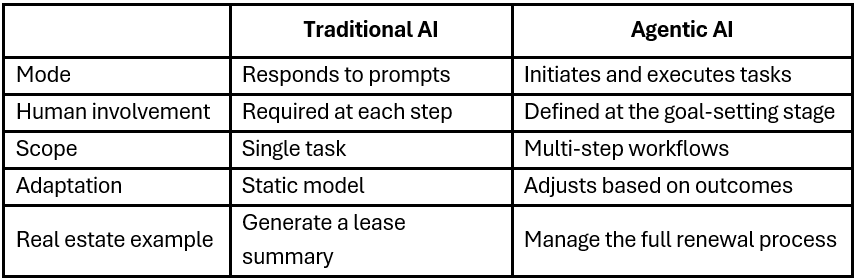
Most AI tools deployed in real estate today are assistive. They answer questions, generate summaries, flag anomalies, and make recommendations. You still make the call. The AI cannot take action.
Agentic AI is different. It doesn't generate responses. It makes decisions and takes action based on those decisions. An agentic system can receive a goal (e.g., reduce vacancy in Building C by 10% this quarter), break it into subtasks, pull data from multiple systems, draft and send communications, schedule showings, and adjust pricing based on market data, all without someone managing each step. The degree of human involvement depends on the goal and the preferences of people overseeing the AI agent.
According to McKinsey's research on agentic AI in real estate, the core shift is from AI as a tool to AI as an operator within a defined domain. That's a meaningful distinction in an industry where operational complexity is high and human bandwidth is a consistent bottleneck.
Traditional AI vs. Agentic AI
Where Agentic AI Is Already Changing Real Estate Operations
Agentic AI impacts several high-value areas of real estate and property management businesses.
1. Leasing and Tenant Acquisition
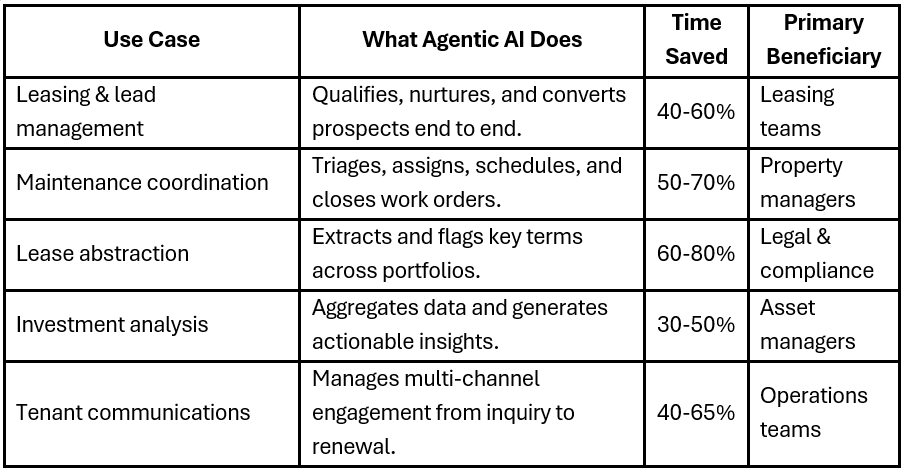
Leasing teams spend a disproportionate amount of time on repetitive tasks: responding to inquiries, qualifying leads, scheduling tours, and following up with prospects. Agentic systems can handle these duties, from first contact to signed lease, with human agents stepping in only for exceptions.
A few commercial platforms have begun embedding AI agents that go beyond CRM logging. They initiate outreach based on lease expiration timelines, adjust messaging based on prospect behavior, and coordinate across channels without manual triggers.
The result isn't just faster leasing cycles. It's leasing teams that can manage more units without proportional headcount growth.
2. Property Management and Maintenance
Maintenance coordination is one of the most operationally messy parts of property management. Tenant requests come in from multiple channels, get triaged incorrectly, and create friction on both sides.
Agentic AI changes the intake-to-resolution loop. When a tenant submits a maintenance request, the agent diagnoses the issue type, checks warranty or service contracts, assigns a vendor, schedules the visit, coordinates access, and closes the ticket, logging everything back into the property management system.
For large portfolios, this isn't a minor efficiency gain. It's a structural shift in how operations scale, reducing manual work by 75% or more.
3. Investment Analysis and Asset Management
On the institutional side, agentic AI is compressing the time it takes to evaluate acquisitions, monitor portfolio performance, and generate recommendations for capital allocation.
What used to require an analyst team pulling data from multiple sources, building models, and writing reports can now be significantly automated. Agentic systems monitor macro indicators, property-level financials, and market comps in real time, then send alerts or draft investment memos when thresholds are crossed.
This connects directly to how AI-driven property valuation models are already changing the speed and accuracy of underwriting. Agentic AI takes that a step further by making those valuation insights actionable inside a continuous workflow.
4. Lease Abstraction and Compliance
Lease abstraction has historically required skilled professionals and significant time. Agentic AI can now read, extract, and cross-reference across lease portfolios at scale, flagging risk, inconsistencies, and upcoming critical dates.
For landlords managing hundreds of leases, this represents a meaningful reduction in both cost and exposure.
Agentic AI Quick Reference
Agentic AI Challenges in Real Estate Applications
Agentic AI in real estate isn't a plug-and-play solution. The common problems firms struggle with include fragmented or incomplete data that degrades the AI’s effectiveness; regulatory compliance issues; getting employees to trust and use the AI; and measuring the success of the new system.
Data Fragmentation
Most real estate organizations run on a patchwork of systems: property management software, CRMs, ERP tools, and spreadsheets. Agentic AI needs clean, connected data to function reliably. Without the integration work being done first, agents make decisions based on incomplete information. This is the same infrastructure problem that makes legacy system modernization a prerequisite before any meaningful AI deployment can happen.
Regulatory Exposure
Real estate is subject to fair housing laws, local eviction regulations, and disclosure requirements. Autonomous AI agents making leasing or pricing decisions need guardrails built explicitly around these constraints from day one, not patched in later.
Trust and Adoption
Property managers and leasing agents who have been doing this for years don't automatically trust an AI system to act on their behalf. Adoption requires demonstrating accuracy, building transparency into what the agent is doing, and giving humans clear override capability.
Unclear Success Metrics
Many real estate operators still measure AI value in hours saved rather than portfolio outcomes improved. Shifting to the right metrics matters for sustaining investment in these systems.
What Leading Operators Are Getting Right
The firms showing meaningful results from agentic AI in real estate start with a specific operational domain rather than a broad AI transformation initiative. They choose one clear, end-to-end workflow with measurable outcomes.
Leaders invest in data infrastructure before AI tooling, so they can start out with clean, integrated data. They also build human oversight into the system as a core design principle, not an exception path. The agent handles the routine; humans handle the edge cases.
These businesses recognize the need to treat compliance as a technical requirement. Fair housing guardrails, audit trails, and explainability are built into the system from the outset.
Finally, property businesses seeing success with agentic AI tools are measuring outcomes at the portfolio or operational level, not just at the task level.
The Future of Real Estate Is Agentic AI
Agentic AI isn't a trend to monitor from a distance anymore. The operational advantages are materializing now. Firms that move with intention will have a structural edge over those that don't.
The key is to start with clearly defined use cases, build the right data foundation, and design AI systems that work alongside people.
The question isn't whether agentic AI will reshape real estate operations. The real question is which businesses will move fast enough to make durable gains over their competitors?
At Taazaa, we specialize in helping mid-market and enterprise organizations that are growing fast but need more capacity, integration, and innovation to scale. If you’re looking to leverage agentic AI within your real estate or property-based business, contact us today.
FAQs
Q: What is agentic AI in real estate, and how is it different from regular AI tools?
Agentic AI refers to AI systems that can autonomously plan, execute, and adapt across multi-step workflows. Unlike generative AI tools that respond to prompts or generate content, agentic AI actively takes actions: scheduling, communicating, analyzing, and updating records within defined parameters. In real estate, that means it can handle entire operational workflows, such as the full leasing cycle or a maintenance request from intake to resolution, rather than just assisting with individual tasks.
Q: Which real estate functions benefit most from agentic AI right now?
Based on current adoption patterns and McKinsey's research, the highest-impact areas are leasing and tenant acquisition, property maintenance coordination, lease abstraction and compliance, and institutional investment analysis. These are high-volume, process-heavy functions where automation compounds significantly at scale.
Q: Is agentic AI practical for mid-market real estate firms, or only for large enterprises?
It's increasingly practical for mid-market organizations, but the starting point matters. Firms with 200 to 1,500 employees and fragmented systems often get the most value from starting with a single, well-defined workflow rather than a broad deployment. The key enabler is data readiness: agentic AI works best when it has access to clean, integrated data across your property management, CRM, and communication systems.
Q: What are the biggest risks of deploying agentic AI in real estate?
The three biggest risks are regulatory exposure (particularly around fair housing laws and AI-driven pricing or screening decisions), poor data quality leading to unreliable outputs, and adoption failure when property managers and leasing teams don't trust or understand what the system is doing. Each is manageable with the right design approach, but they need to be addressed intentionally from the start.
Q: How long does it take to see ROI from agentic AI in property management?
Results vary significantly based on portfolio size and implementation maturity, but organizations with strong data infrastructure and a focused use case often see measurable efficiency improvements within 60 to 90 days. Full operational ROI, measured at the portfolio level, typically plays out over six to 12 months as the system learns and processes are refined.